
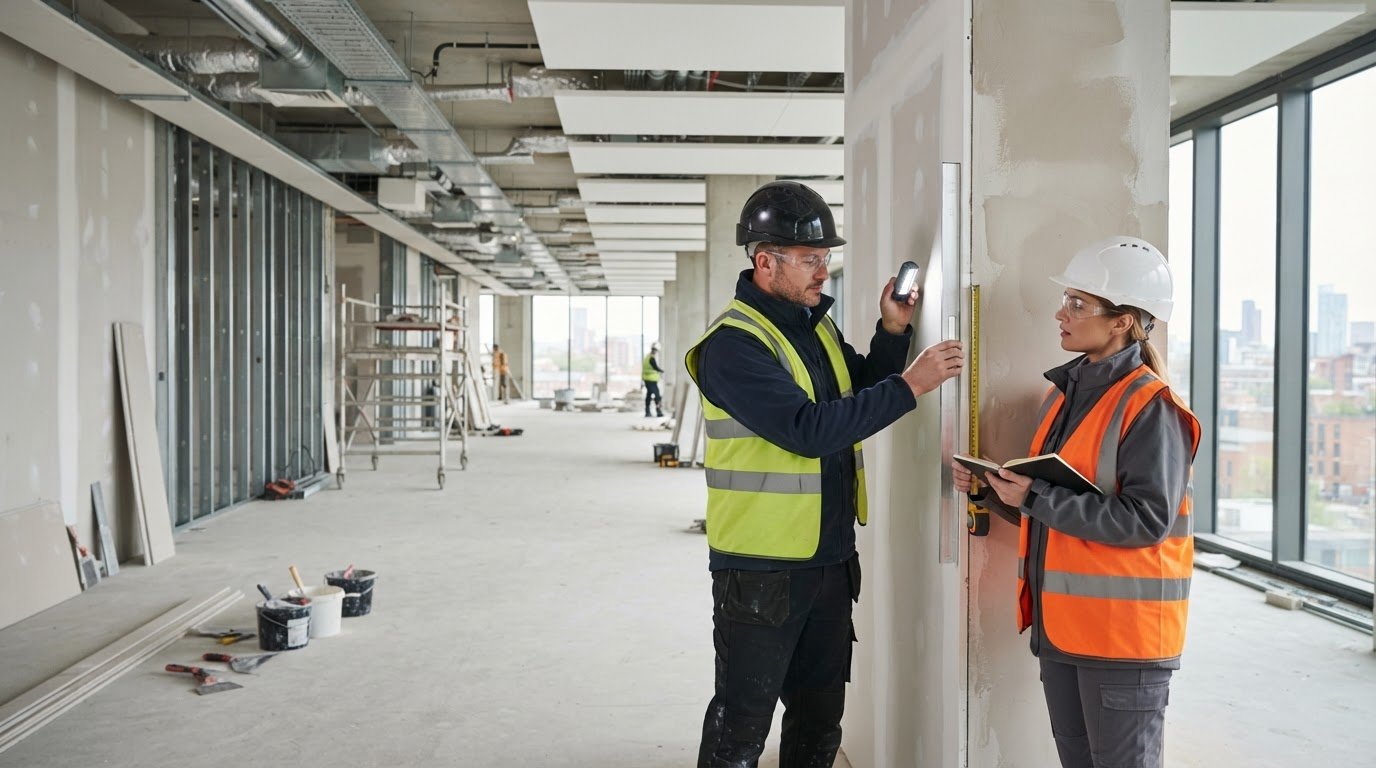
A full skim isn’t automatically the safer choice for a clean, reliable finish. The right approach depends on the board system, specified finish and site programme. Choosing a drywall taping jointing subcontractor on price or habit alone can leave important scope questions unanswered. If you’re comparing tenders, you need clarity on what preparation, finishing and remedial work each package includes.
This article compares taping and jointing with skim plastering, including how board edges and the required finish influence the decision. It also explains how to assess subcontractors against your project’s quality, programme and coordination requirements, rather than relying on headline rates or broad assurances.
You’ll find practical points to include in the tender scope, from responsibility for board readiness and interfaces to inspection stages, drying between coats and handover. Clear requirements help you compare like with like, plan around other trades and reduce the risk of finish defects becoming a late-stage dispute.
Key Takeaways
- Choose taping and jointing or skim plastering by checking the specified board, intended decoration and acceptance criteria.
- Assess board condition, joint alignment, fixings and edge profile before agreeing the finishing scope.
- Compare every drywall taping jointing subcontractor against the same tender information, including exclusions, quality checks and relevant experience.
- Plan staged inspections and coordinate access, lighting, protection and follow-on decoration to manage finish quality on site.
- Issue drawings, quantities, programme assumptions and inspection requirements with the enquiry to support a clear, comparable package.
Taping and jointing or skim plastering: which finish suits the project?
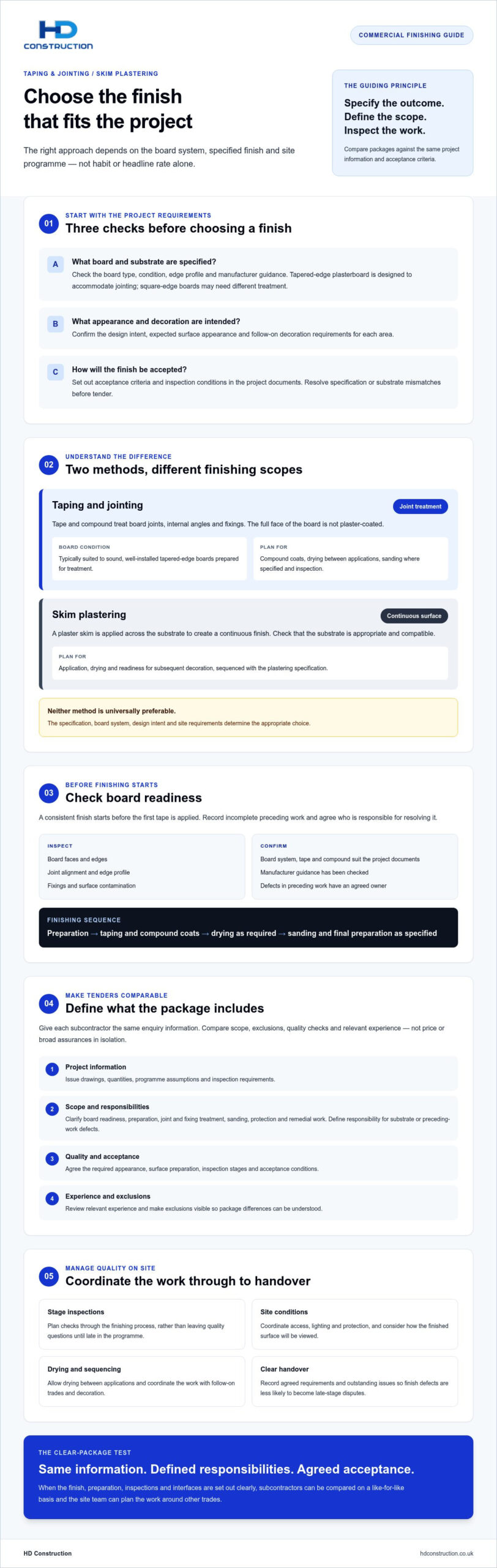
Start with the project requirements, not a trade preference. Check the specified substrate, required appearance and intended decoration. Tapered-edge plasterboard is designed to accommodate jointing, while square-edge boards may need a different treatment. Confirm the board manufacturer’s guidance and project specification before selecting a system.
Taping and jointing treats plasterboard joints and fixings to create a decoration-ready surface, without applying plaster across the entire face of the board. Skim plastering, by contrast, applies a continuous plaster coat over the substrate. The methods have different scopes and can produce different surface characteristics. Neither is universally preferable: the design intent, specification and site requirements determine the choice. For background on the board and finishing process, see Drywall installation and finishing.
| Decision factor | Taping and jointing | Skim plastering |
|---|---|---|
| Suitable board condition | Typically suited to sound, well-installed tapered-edge boards, with joints and fixings prepared for treatment. | May be specified over an appropriate substrate where a full plastered surface is required; check substrate compatibility. |
| Finishing scope | Tape and compound treat joints, internal angles and fixings, rather than coating the full board face. | A plaster skim is applied across the surface to create a continuous finish. |
| Programme | Allow for compound coats, drying between applications, sanding where specified and inspection. | Plan for application, drying and readiness for subsequent decoration. Confirm sequencing with the plastering specification. |
| Acceptance | Agree the required appearance, surface preparation and inspection conditions in the package documents. | Set out the specified plaster finish and acceptance process, including relevant substrate requirements. |
What does a commercial taping and jointing package cover?
A package generally sets out how tape and jointing compound will treat board joints, internal angles and fixings. This is joint treatment, not full-surface plastering, so don’t assume the two methods provide identical outcomes. Before appointing a drywall taping jointing subcontractor, confirm whether board preparation, sanding, protection and remedial work are included. Also define who must resolve defects in the substrate or preceding installation.
When should the project specification favour a skim finish?
A full skim may be specified where the design calls for a continuous plastered surface. Assess the board type and condition, expected appearance, decoration and follow-on trade requirements before recommending it. For example, a wall scheduled for a particular paint finish may have different acceptance needs from one receiving a wall covering. Review the project documents and manufacturer guidance together, and resolve any mismatch before tender rather than assuming one method will suit every area.
How the board, jointing method and site conditions affect the finished surface
A consistent finish starts before the first tape is applied. Board installation, preparation, jointing materials, drying conditions and work sequencing all affect the completed surface and when it is ready for decoration. A well-defined package helps the site team identify readiness issues early, instead of leaving responsibility unclear once finishing is under way.
What should be checked before jointing begins?
Inspect the board face and edges, joint alignment and fixings before work starts. Damaged edges, uneven joints, protruding fixings or surface contamination may need attention before finishing can proceed properly. Record incomplete preceding work and agree who will resolve it, so the issue doesn’t become a quality dispute or interrupt the programme.
Check that the board system, tape and compound align with the project documents and relevant manufacturer guidance. The finishing sequence typically moves from preparation to taping and compound coats, allowing each application to dry as required before the next. Sanding and final surface preparation should follow the specified system. Give a drywall taping jointing subcontractor clear information about access, sequencing and any constraints that could affect this process.
How do finish expectations and lighting affect acceptance?
Surface appearance depends partly on where and how it will be viewed. Light falling across a wall at a shallow angle can make joints or surface variations more noticeable than diffuse lighting. Decoration matters too: agree the finish with the specified paint, wall covering or other treatment, rather than relying on an assumed universal standard.
Agree finish acceptance against the project specification and the viewing conditions expected at inspection. Before production work proceeds, confirm whether a sample area is required, who will review it and what lighting conditions will apply. Record the agreed benchmark and apply it consistently across the relevant areas.
Site conditions and sequencing need the same attention. Follow product guidance for application and drying, and coordinate finishing with ventilation, access, protection and follow-on trades. Ask tenderers how they will check workmanship, record inspections and track corrective work against the project’s quality process.
Clear readiness checks and agreed inspection conditions make quality control more practical. For information about how taping and jointing relates to drylining and plastering interfaces, see HD Construction’s taping and jointing service.
How to compare drywall taping and jointing subcontractors fairly
A fair comparison starts with a common tender scope. If one bidder includes board preparation and remedial work while another excludes them, their totals don’t represent the same package. Issue consistent drawings, quantities, finish requirements and programme information, then assess every response against the same criteria.
Consider delivery capability alongside the tender sum. A drywall taping jointing subcontractor should explain how the proposed team, supervision and quality checks relate to the project’s scale, sequence and access arrangements. Ask bidders to identify dependencies on preceding trades and explain how they would manage areas that aren’t ready when planned.
What evidence should a main contractor request?
Request relevant commercial project examples and references where available, then check whether the work is comparable in scope and finish expectations. Ask for written quality procedures, if available, and how inspections, defects, corrective work and completed areas are recorded. If a bidder cites certification, accreditation or a guarantee, verify the claim directly before treating it as evidence. Don’t infer credentials from general statements about experience.
How can tender scope and commercial terms be compared?
Compare like with like. For a fixed-price proposal, check the assumptions and inclusions behind the total. For a measured-rate proposal, confirm the measurement basis, rates and valuation rules. Assess each against the same scope and quantities before ranking the figures.
Use a concise tender checklist to capture the differences:
- Areas, quantities, board interfaces, preparation and required finish.
- Access, working sequence, protection and responsibility for waste.
- Programme assumptions, proposed supervision and workforce planning.
- Inspection records, defect correction and remedial responsibility.
- Exclusions, variation procedures and valuation stages.
Clarify who provides access and protection, who prepares the substrate, and how variations will be agreed if site conditions differ from the tender information. Where contract terms allow, link payment assessments to defined completed work and agreed inspection stages. This makes progress easier to measure and clarifies what supports each valuation.
Record qualifications and unresolved scope gaps before appointment, rather than relying on later discussion to settle them. A consistent evaluation separates technical and delivery suitability from commercial structure, helping the project team select a subcontractor on clear, comparable evidence.
How to control quality, programme and trade interfaces on site
Quality and programme are easier to manage when each area moves through clear readiness, finishing and release stages. The main contractor, drylining team and finishing subcontractor should agree who checks each stage, how issues are recorded and when follow-on trades can proceed. This gives the drywall taping jointing subcontractor a workable sequence and the wider team a consistent basis for inspection.
How should the work be sequenced with other trades?
Confirm preceding drylining work is complete and the area is ready before finishing starts. Agree access, service coordination, protection and area release points with the relevant site teams. Programme compound coats and drying periods in line with product guidance and actual site conditions, using approved programme information rather than assumed durations. Decoration and other follow-on activities should start only after the agreed finish checks are complete.
Use a staged control process:
- 1. Confirm readiness. Check that the area is accessible, preceding work is complete and any constraints are recorded with the responsible party.
- 2. Approve a sample area. Where required, agree the sample and inspection conditions with the project team before applying the benchmark across the work.
- 3. Inspect at agreed stages. Check the work against project requirements at suitable points, including before an area is covered or released.
- 4. Record and correct defects. Log the location, agreed corrective action and responsible party, then arrange reinspection before release.
- 5. Complete handover. Record inspected areas, outstanding items and agreed next steps accurately in the project quality process.
Which quality checks support a clean handover?
Inspect joints, internal angles, fixings and surface preparation against the approved project requirements and any agreed sample. Make inspection conditions clear, including access and lighting, so the team assesses the finish consistently. If defects are identified, record them against specific areas rather than relying on a general note, and verify corrective work is complete before decoration proceeds.
Keep inspection records aligned with actual progress. Don’t mark a completed area as accepted if corrective work remains outstanding, and make unresolved items visible at handover. This clarifies responsibility between the finishing team and follow-on trades, while helping the main contractor plan area release and valuations against inspected work.
For information about a taping and jointing package alongside drylining and plastering interfaces, see HD Construction’s service information.
Appointing a taping and jointing subcontractor: define the package and next steps
Before appointment, confirm the finish specification, substrate, package boundaries and acceptance process. A clear brief lets tenderers price the same work and helps the project team coordinate responsibilities from board installation through to handover. It also gives you a sound basis for comparing a drywall taping jointing subcontractor beyond the tender total.
What information should a subcontractor receive for pricing?
Issue a coordinated tender enquiry with the information needed to understand the work and its constraints. Include:
- Current drawings, specifications and quantities, identifying the areas and board types in scope.
- The required finish, decoration assumptions and any sample or inspection requirements.
- Programme dates, access arrangements, site constraints and relevant sequencing information.
- Preparation requirements, protection, exclusions and responsibilities at interfaces with other trades.
- The proposed commercial basis, whether fixed-price or measured-rate, with the applicable quantities and valuation method.
Ask each tenderer to state assumptions, qualifications, exclusions and any rates for changes clearly. This makes differences visible before appointment. If board condition, access or work sequence depends on others, set out the relevant dependencies rather than leaving bidders to make different assumptions.
How can HD Construction support a coordinated finishing package?
HD Construction offers taping and jointing alongside drylining and plastering, giving project teams the option to discuss related scopes and interfaces with one contractor. That doesn’t mean every project should combine them. The specification, procurement strategy and responsibility boundaries should determine whether the work is tendered together or separately.
For related guidance, consult Commercial Plastering Contractor: A Guide to Scope, Quality and Delivery and Commercial Drylining: Technical Specifications, Systems, and Site Installation Standards. These topics can help inform finishing and board-system requirements, while the tender documents should remain the project’s controlling reference.
Before appointment, check that the selected scope aligns with the intended finish, board system, programme and agreed inspection arrangements. Confirm package inclusions, exclusions and delivery capacity with the tenderer, then record agreed responsibilities and valuation stages in the contract documents.
To discuss a project-specific scope, Discuss a taping and jointing package with drawings, quantities, programme assumptions and inspection requirements ready.
Set a clear scope before appointing your finishing subcontractor
The right finish depends on the specified board, intended appearance and decoration, not a default preference for jointing or skimming. Before appointment, define the substrate, package boundaries, acceptance criteria and responsibility for preparation and remedial work. Issue consistent drawings, quantities, programme assumptions and inspection requirements so tenderers can be compared on the same basis.
Site readiness, compound drying and trade sequencing also affect delivery. Agree inspection stages, viewing conditions and area release points with the project team, then record corrective actions and handover status. These controls make quality expectations visible and keep interfaces clear.
HD Construction provides taping and jointing alongside drylining and plastering, supporting discussion of related interfaces where the project requires it. Commercial packages can be structured on a fixed-price or measured-rate basis, with the scope and valuation approach defined for the work. If you’re assessing a drywall taping jointing subcontractor, prepare your project information and discuss a taping and jointing package. A clear brief is a practical first step towards a well-coordinated finish.
Frequently Asked Questions
What does a drywall taping and jointing subcontractor do?
A drywall taping and jointing subcontractor finishes plasterboard joints and fixings using tape and jointing compound, preparing the surface to the agreed project specification. The package may include internal angles and surface preparation, but inclusions vary, so confirm whether sanding, protection and remedial work are covered. The scope should also state how board readiness, inspections and interfaces with drylining or plastering work are managed.
Is taping and jointing better than skim plastering?
Neither method is automatically better. The project specification, board system and design intent determine the suitable finish. Taping and jointing treats joints and fixings, while skim plastering applies a continuous plaster coat across the surface. Check the required appearance, intended decoration, substrate and follow-on work before choosing. Agree acceptance criteria and any sample requirements before tender, rather than assuming the methods produce identical surface outcomes.
Can you tape and joint any plasterboard?
No. Board type, edge profile, condition and manufacturer’s guidance affect whether a taping and jointing system is appropriate. Tapered-edge plasterboard is commonly designed for joint treatment, but confirm the specified board and compatible tape and compound in the project documents. Square-edge boards or damaged, poorly aligned boards may need a different approach or preparation. Resolve substrate concerns before finishing starts to avoid unclear responsibility.
How do I compare taping and jointing subcontractor tenders?
Compare each tender against the same scope, drawings, quantities and finish requirements. Check included preparation, board interfaces, exclusions, access assumptions, programme, supervision, inspections and responsibility for remedial work. Review relevant project evidence and how defects and completed areas are recorded. For fixed-price and measured-rate proposals, confirm the assumptions and valuation basis. This allows you to assess delivery suitability as well as the commercial offer.
What causes defects in taped and jointed plasterboard?
Defects can result from damaged or poorly fixed boards, misaligned joints, unsuitable preparation, inconsistent application or materials that don’t match the specified system. Compound that hasn’t dried sufficiently before the next stage can also affect the finish. Site conditions and rushed sequencing may create further risks. Strong or low-angle lighting can make surface variations more visible, so agree viewing conditions and acceptance requirements before inspection.
What information should I provide when requesting a taping and jointing quote?
Provide current drawings, specifications, quantities, board types and the required finish, along with programme dates and site access assumptions. Identify sample approvals, inspection stages, protection requirements, exclusions and interfaces with other trades. State whether you want a fixed-price or measured-rate proposal, and ask tenderers to list assumptions and qualifications. Clear information helps a subcontractor assess the scope consistently and identify unresolved site dependencies before pricing.