

A fixed price is not the same as an unchangeable price. In UK design and build procurement, the main contractor takes responsibility for both design and construction for an agreed lump sum. The contract price is set at the outset, giving a degree of design and build cost certainty if the employer does not request changes during construction. Traditional procurement can also use a fixed-price lump sum, but the employer appoints the professional team to complete the design before appointing the contractor.
Both routes can establish a defined contract sum, but they allocate design responsibility and the effects of project changes differently. That distinction matters when setting a budget and deciding how much control the employer needs over the finished design.
This comparison explains how each route sets and adjusts the price, what happens when the scope changes, and where design and construction risks sit. It provides a practical basis for weighing cost certainty against flexibility and choosing an approach that suits the project.
Key Takeaways
- Compare who completes the design and who builds the works: this determines where responsibility sits and how closely you control detailed design.
- Set clear employer’s requirements and examine the contractor’s proposal carefully to establish a reliable scope and tender price.
- Allow for changes to affect the agreed sum or programme, and use disciplined change management to keep their effects visible.
- Look beyond the headline lump sum: variations, provisional sums and fluctuations can alter the amount payable under a fixed-price contract.
- Choose the procurement route that best matches your priorities for budget predictability, design control and management of project risk.
What is the design and build procurement route?
In UK design and build procurement, one main contractor takes responsibility for design and construction under an agreed contract. The employer’s requirements and contractor’s proposals define the scope, price basis and design obligations.
Employer Requirements and Contractor Proposals
The employer’s requirements describe the project’s intended use, performance, scope and quality expectations. The contractor’s proposals explain how the design and construction will meet them, forming the basis of the tender price and contract. Unlike traditional procurement, the employer appoints the contractor before the design is complete. Clear requirements and a careful review of the proposals help reduce scope gaps and design risk.
To obtain a reliable estimate before tender, prepare coordinated requirements, provide available site and specification information, and allow adequate time for the contractor’s proposal and pricing. The main cost drivers include scope, specification, site conditions and design responsibility. For UK projects in 2026, there is no single design and build cost per square metre: location, scope and specification shape the estimate. A project-specific price depends on the case and is given after a quote request, with the scope and site conditions among the factors assessed.
The contract price covers the work and obligations defined in the contract documents. Those documents should identify exclusions, provisional sums, client-supplied items and allowances, because each can affect the final amount payable.
Fixed-Price and Open-Book JCT Contracts
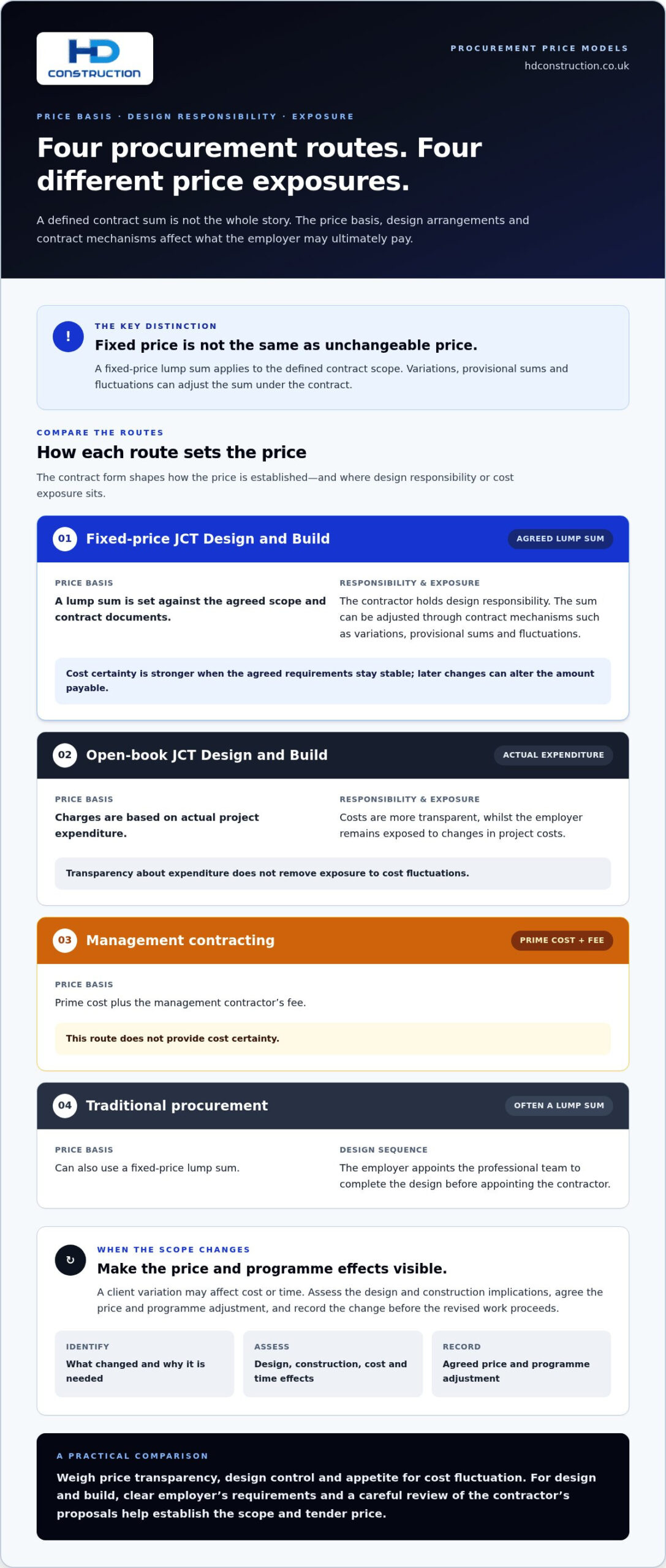
A fixed-price JCT Design and Build contract sets a lump sum against the agreed scope. The sum is generally adjusted only through mechanisms such as variations, provisional sums and fluctuations. An open-book JCT Design and Build arrangement instead charges actual project expenditure. This can make costs more transparent while leaving the employer exposed to changes in project costs.
| Option | Price basis | Responsibility and cost exposure |
|---|---|---|
| Fixed-price JCT Design and Build | Agreed lump sum | Contractor holds design responsibility; adjustments can apply under contract mechanisms. |
| Open-book JCT Design and Build | Actual project expenditure | Transparent costs; employer remains exposed to fluctuations. |
| Management contracting | Prime cost plus management contractor’s fee | Does not provide cost certainty. |
| Traditional procurement | Often a fixed-price lump sum | Design is completed before the contractor is appointed. |
The Joint Contracts Tribunal lists its Design and Build Contract (DB) and Major Project Construction Contract (MP) as design and build forms. The JCT Design and Build Contract 2024 was published in April 2024; NEC4, the current NEC Engineering and Construction Contract edition, was published in 2017. Choose by weighing the required price transparency, design control and appetite for cost fluctuation.
Management contracting differs from fixed-price design and build: the JCT Management Building Contract is a prime-cost contract plus the management contractor’s fee. Regional pricing also reflects factors such as labour and material markets, transport, access and site conditions. Their effect depends on the project’s location and requirements.
Flexibility and project variations
Design and build can accommodate client changes during construction, but each variation may affect the price or programme. The contract’s change process makes those effects visible before the revised work proceeds.
Client Variations
A client variation changes the agreed design, specification or scope after the contract is let. For example, changing a room layout may require revised drawings, materials and installation sequencing. The contractor advises on the cost or time effects, helping the employer weigh the requested outcome against the budget and programme. This differs from the original tender, which prices the agreed requirements, not later choices.
Variation and Change Management
Change management records what has changed, why it is needed and how it affects delivery. A disciplined process identifies the instruction, assesses its design and construction implications, then records the agreed price and programme adjustment. This gives the project team a clear record instead of relying on informal site discussions. It also separates client-led changes from work already included in the contract scope.
Design and build can be responsive when client variations arise as a project develops. Progress still depends on clear decisions and timely information: a late specification change can affect procurement, sequencing and completion. The Hackitt Review criticised design and build contracts for enabling uncontrolled, undocumented changes that were poorly designed and departed from the original design intent. Recording each change supports traceable decisions and protects the integrity of the agreed design.
Price Certainty Under Variations
A fixed-price contract establishes a lump sum for the defined scope, not for every later change. Under a JCT Design and Build fixed-price contract, variations, provisional sums and fluctuations are mechanisms that can adjust the sum. The employer therefore has greater price certainty when requirements stay stable, while requested changes can alter the amount payable. Assessing cost and time effects before authorising a variation keeps the budget forecast current.
Contract Clauses for Cost Increases
UK construction contracts address changes through their terms for variations, provisional sums and fluctuations. These mechanisms explain how adjustments are valued and recorded; they do not make every cost increase disappear. The contract should define the scope, the treatment of allowances and how changes are instructed. For a data centre project, planning construction changes alongside design decisions can help keep the delivery implications visible.
Before tender, employers can reduce uncertainty by resolving key requirements and identifying likely changes. During delivery, log each proposed variation, obtain the contractor’s cost and time assessment, and record the decision through the contract process. This gives the project team a consistent basis for comparing the original tender with the revised forecast, while keeping design intent and construction coordination aligned.
Allocation of design and construction risk
Procurement determines who carries design, construction and budget risks. The contract, scope and client decisions shape how those responsibilities are allocated.
Budget Risk and Cost Certainty
A fixed-price JCT Design and Build contract places substantial design responsibility with the contractor. The client is protected from additional costs arising from design issues unless the client caused them through changes. This differs from traditional procurement, where the client retains the risk of consultant or contractor non-performance. The client’s appetite for risk therefore affects whether a fixed price or a more transparent cost arrangement is suitable.
Design Responsibility and Risk
Under design and build, one entity is responsible for both design and construction, with the contract defining the extent of that responsibility. The contractor has greater design responsibility than under a traditional contract with a contractor’s designed portion. Traditional procurement, by contrast, separates design and construction, typically using multiple consultants and contractors. Once a design and build contract is let, the employer has no direct control over the contractor’s detailed design.
Inflation, Contingency and Provisional Sums
Inflation can affect a project budget through changing material prices and labour rates, particularly under open-book arrangements. A fluctuation mechanism in a fixed-price contract can also adjust the lump sum. A contingency is a budget allowance for uncertainty, not a guaranteed contract payment. Provisional sums cover work that is not fully defined; once the scope is resolved, the amount can be assessed under the contract’s valuation process.
Factors Affecting Project Cost Certainty
Cost certainty depends on the clarity of the employer’s requirements, the contractor’s proposal and the agreed scope. It also reflects the contract’s treatment of variations, provisional sums and fluctuations. Inadequate requirements or insufficient scrutiny of the proposal can create design and quality risks. These factors distinguish a defined lump sum from an open-book arrangement, where actual project expenditure is charged and cost changes remain visible.
Risk allocation also differs under management routes. In construction management, the employer appoints and administers each trade contract, taking on greater construction risk than under traditional or design and build procurement. Management contracting does not provide cost certainty: the JCT Management Building Contract is a prime-cost contract plus the management contractor’s fee. These routes may suit clients willing to manage more direct exposure in exchange for a different delivery structure.
To assess a project, map each risk to the responsible party, then identify how the contract treats cost changes. For example, distinguish a contractor design issue from a client-requested change, and separate an allowance from a firm scope item. The balance matters: different procurement and pricing arrangements allocate design responsibility and cost exposure in different ways. The selected contract should match the client’s control requirements and risk appetite.
Cost certainty and fixed construction costs
A fixed lump sum gives the employer a defined contract price for an agreed scope. Its practical value depends on what the contract includes and how it treats adjustments.
Fixed-Price and Lump-Sum Arrangements
Under a fixed-price JCT Design and Build contract, the employer and contractor agree a lump sum against the contract documents. This provides a clear cost baseline, unlike open-book pricing, which charges actual project expenditure. The sum is generally adjusted only through mechanisms such as variations, provisional sums and fluctuations. The benefit depends on a well-defined scope, accurate allowances and effective change management.
Fixed Construction Costs
Fixed construction costs are the agreed costs for the defined work, not a promise that every later decision has no price effect. A client-requested change can alter the sum, as can a provisional sum or a fluctuation mechanism. Traditional procurement can also use a fixed-price lump sum, but the employer’s professional team completes the design before appointing the contractor to build it.
The key procurement question is what the agreed price covers. An employer should read the contract documents as a set: requirements, contractor’s proposals, specifications, drawings, schedules and any stated exclusions. For example, if a specified finish appears in the requirements and proposal, it forms part of the priced scope. If an item is treated as a provisional sum, its final cost depends on the work later defined and valued.
Design and build cost certainty comes from fixing a clear scope and managing departures from it. A tender price is more useful when the employer resolves key design decisions before tender, rather than leaving substantial choices open. Value engineering takes place at the outset, allowing the team to consider cost and specification together before agreeing the construction price.
Traditional procurement can give the employer greater certainty about design quality because the professional team completes the design first. Its fixed-price tender can then be based on the designed work. Design and build instead combines design and construction responsibility in one contractor, with the contract defining the scope and design obligations. Neither method removes the need to document assumptions and price adjustments.
Under a fixed-price JCT Design and Build contract, the employer is protected from additional design costs unless the employer caused them through changes. A well-defined scope, accurate provisional sums and robust change management limit client risk. The employer should therefore compare the contract sum with its included scope, allowances and adjustment mechanisms, rather than treating the headline figure as the entire cost position.
To assess whether a fixed price supports the project budget, identify the work included, separate firm scope items from allowances, and record how variations and fluctuations are handled. That review shows where the contract retains price certainty and where later decisions can change the amount payable.
Cost certainty in design and build
Design and build cost certainty depends on how well the team controls scope, design decisions and cost information during delivery. Strengthen it by agreeing requirements, pricing a sufficiently detailed proposal, recording changes and updating the forecast as decisions are made.
Start before tender. Single-stage tendering works when enough information exists to calculate a realistic price. Prepare coordinated drawings, specifications and employer’s requirements, then identify unresolved decisions and provisional sums. This gives the contractor a clearer basis for pricing and lets the employer compare proposals against the same scope, rather than comparing headline sums based on different assumptions.
During design development, use a cost plan to track each package against the agreed scope. A consultant can review design information and flag where a specification choice changes quantities, interfaces or buildability. Resolve those items before they flow into detailed drawings and procurement. Design and build can run design and construction in parallel, but cost control still depends on timely decisions and clear responsibility for design information.
- Record the agreed scope, assumptions and exclusions alongside the tender price.
- Track provisional sums separately from fully defined work packages.
- Assess each proposed change for cost and programme effects before approval.
- Update the forecast when design, procurement or site information changes.
Value engineering can help the team assess design options against project requirements. Compare alternatives against the required performance, durability and specification, then record the selected option before pricing is finalised. This makes value decisions part of the design method, rather than late reductions that may affect quality or create rework.
Open-book reporting can strengthen cost visibility by linking expenditure to contractor cost codes and supporting valuations with invoices on request. This shows a forecast outcome, not a guaranteed saving; competitive tendering, sourcing and efficient supply-chain management remain important to value for money.
At each cost review, compare the current forecast with the contract sum and explain movements by cause. Separate client variations from fluctuations, provisional sums and changes in actual expenditure. This gives the employer a traceable view of budget exposure and supports decisions while options remain available. A clear record also helps the contractor and consultant resolve discrepancies before they affect completed work.
For a project requiring coordinated design and delivery, discuss your design and build project with a team that can align scope, design information and construction planning.
HD Construction: Drylining
HD Construction delivers Drylining for projects where interior wall and ceiling packages form part of the wider construction scope. Its work also includes Plastering, SFS (Steel Framing System) and Taping & Jointing, supporting defined interior requirements within a Design & Build project.
Bring these packages into scope early, so specifications, interfaces and responsibilities can be considered during design and tender preparation. This gives the project team a clearer basis for coordinating the interior work with the wider programme and contract documents.
For Drylining or related interior construction requirements, contact HD Construction to discuss your project.
Plan the next project decision
Before settling the procurement route, identify which interior packages need a defined scope and coordinated design input. Clear package boundaries help the project team set responsibilities and carry design decisions into tender documents, giving contractors a consistent basis for their proposals. This groundwork supports design and build cost certainty by connecting the agreed requirements with the work priced and delivered.
For projects that include interior wall systems, finishes or framing, HD Construction provides Drylining, Plastering and SFS (Steel Framing System). Discussing these requirements as part of the project helps align the relevant work packages with the wider design and construction approach.
When you’re ready to discuss your project’s interior construction requirements, contact HD Construction. A clear scope is a practical starting point for a well-coordinated project.
Frequently Asked Questions
Should I go D&B or Traditional Route?
Choose design and build if you want one contractor to take responsibility for both design and construction. Choose traditional procurement if retaining greater influence over a completed design is more important. For example, a project with settled performance requirements may suit design and build, while a client with detailed design priorities may prefer to appoint the professional team first. Compare design control, responsibility and tolerance for change before selecting the route.
What is single-stage design and build?
Single-stage design and build tendering works when enough project information exists for contractors to calculate a realistic price. The employer issues its requirements, and the tendering contractor submits proposals and a price against them. This differs from seeking a price before key scope information is ready. Clear drawings, specifications and performance expectations help bidders price a consistent project basis, making tender comparisons more meaningful.
What does cost certainty mean in UK design and build construction?
Cost certainty means having an agreed financial baseline for the defined project scope, with contract terms governing how the amount may change. It does not mean every later decision or cost movement is absorbed into the original sum. The design and build cost certainty available to an employer depends on scope clarity and the contract’s adjustment mechanisms. A useful test is whether each allowance and assumption has a clear treatment.
How does design and build compare with traditional procurement for cost certainty?
Both routes can use a fixed-price lump sum, so the procurement label alone does not determine budget reliability. Design and build places design and construction responsibility with one contractor, while traditional procurement completes the design before tendering the work. Consider where design decisions remain open: late changes can affect either route, but design responsibility and the process for valuing changes differ under the contract.
How do fixed-price and lump-sum design and build contracts work in the UK?
A fixed-price, lump-sum contract sets an agreed amount for the defined work and obligations in its documents. The employer should read the drawings, specifications, requirements and contractor’s proposals together to understand the priced scope. Contract mechanisms may adjust the sum for variations, provisional sums or fluctuations. For instance, an undecided finish treated as a provisional sum is not equivalent to a fully specified, included item.
What risks can cause a design and build project to exceed its budget?
Budget pressure can arise from client changes, incomplete employer’s requirements, unclear provisional sums or design proposals that have not been examined closely. Under open-book arrangements, material prices, labour rates and other fluctuations can also affect expenditure. A practical control is to maintain a change log showing each decision, its price and programme effect, then update the forecast. This makes emerging cost exposure visible before it is absorbed into later work.