

Accreditation alone does not secure a place on a public-sector construction contract. Requirements vary by buyer and work package, but a subcontractor pre-qualification questionnaire in construction commonly covers health and safety, quality, environmental management, financial standing and relevant experience. Buyers may also require SSIP membership, such as CHAS, alongside other specified accreditations.
It is reasonable to want a clear list before preparing evidence, but there is no universal set of certificates for every tender. The buyer assesses whether the proposed subcontractor can meet the contract requirements and deliver its work safely and reliably. This guide explains the accreditations and supporting documents buyers may request, what they assess, and how pre-qualification helps identify suitable suppliers before tendering. It also explains how an organised evidence pack can support a main contractor’s submission and make procurement decisions more focused.
Key Takeaways
- Prepare evidence across health and safety, quality and environmental management, as buyers may assess all three areas.
- Show how relevant project examples and technical references demonstrate the main contractor’s ability to deliver the proposed works.
- Understand how company details, financial information and exclusion grounds inform a buyer’s assessment of procurement suitability.
- See how pre-qualification helps buyers verify submissions, apply minimum criteria and identify suitable bidders for the tender stage.
Health and safety, quality and environmental requirements
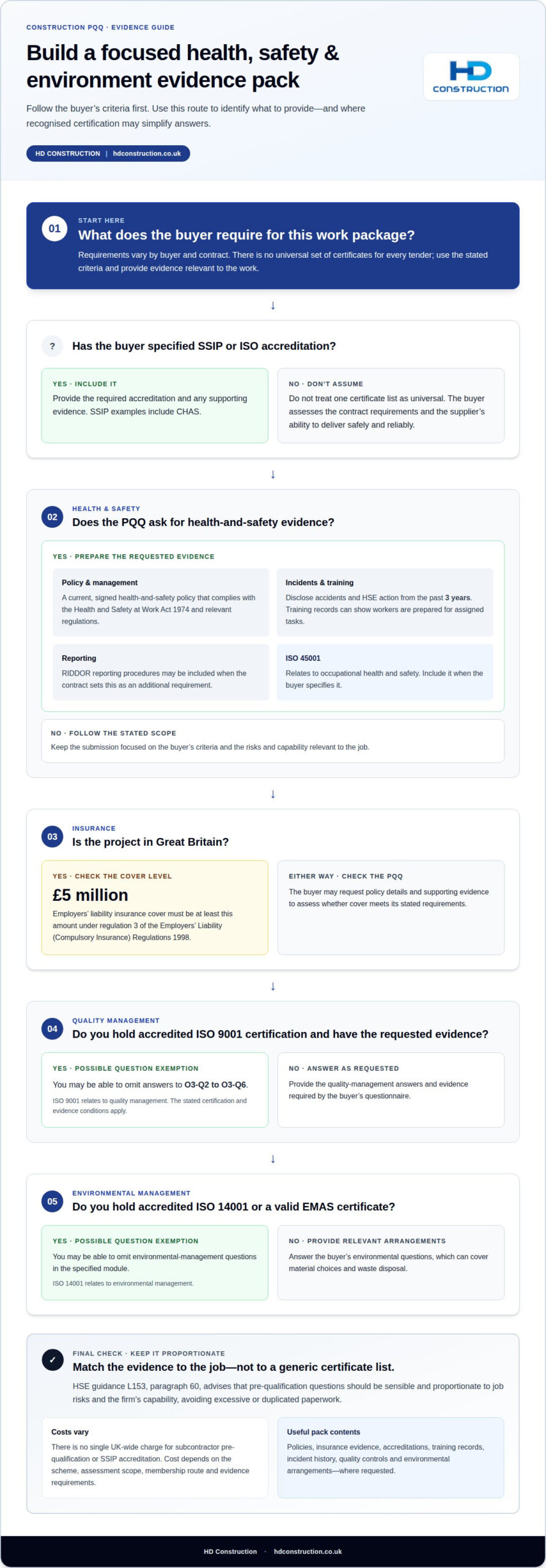
A construction PQQ can assess health and safety, quality and environmental management together. Buyers may require SSIP accreditation, such as CHAS, and may also specify ISO certification. ISO 45001 relates to occupational health and safety, ISO 9001 to quality management, and ISO 14001 to environmental management. The required criteria depend on the contract and the buyer’s assessment.
Insurance evidence is another common part of the submission. In Great Britain, employers’ liability insurance cover must be at least £5 million under regulation 3 of the Employers’ Liability (Compulsory Insurance) Regulations 1998, according to The National Archives (legislation.gov.uk). A PQQ can request policy details and supporting evidence, so the buyer can assess whether cover meets its stated requirements.
Health and safety evidence may include a current, signed policy that complies with the Health and Safety at Work Act 1974 and relevant regulations. Subcontractors may also need to disclose accidents and HSE action from the last three years. Training records can show workers are prepared for their assigned tasks, while RIDDOR reporting procedures may form part of a contract’s additional requirements.
Environmental questions can cover material choices and waste disposal. An accredited ISO 14001 certificate or valid EMAS certificate may allow an organisation to omit environmental-management questions in the specified module. Accredited ISO 9001 certification, with requested evidence, may allow answers to questions O3-Q2 to O3-Q6 to be omitted.
There is no single UK-wide charge for subcontractor pre-qualification or SSIP accreditation. Costs depend on the scheme and assessment scope; the membership route and evidence requirements also affect the price.
HSE guidance L153, paragraph 60, advises that pre-qualification questions should be sensible and proportionate to the job’s risks and the firm’s capability, avoiding excessive or duplicated paperwork, according to the Health and Safety Executive. This keeps the assessment focused on relevant evidence.
A useful PQQ request sets out the required policies, insurance evidence, accreditations, training records, incident history, quality controls and environmental arrangements. Clear criteria help subcontractors provide evidence that matches the work.
Main contractor financial standing and experience
A PQQ assesses whether the main contractor has the financial capacity and relevant experience to manage the contract. Buyers may compare annual turnover with the contract’s annual value; one stated benchmark is turnover at least twice that value. Financial information gives the buyer context for assessing delivery capacity, but does not prove that the proposed supplier can perform every specialist task.
Under regulation 8 of the Construction (Design and Management) Regulations 2015, anyone appointing a contractor must take reasonable steps to check skills, knowledge and experience. For a firm, the assessment also covers its organisational capability to carry out the work safely. Northern Ireland has separate CDM 2016 Regulations, so the applicable framework depends on where the project takes place.
Experience evidence should relate directly to the tendered works. UK public-sector PQQs commonly request two to three comparable case studies from the past three to five years. Examples can describe the scope delivered, the supplier’s role, technical challenges and how the work was completed. References help buyers verify that the examples reflect genuine projects and relevant performance.
Technical competence is assessed against the work’s complexity and risks. A buyer may review staff experience, delivery arrangements and relevant certification, then assess whether they match the proposed scope. For design work, the PQQ may ask whether designers have arrangements for meeting their duties under the CDM Regulations. Clear, comparable evidence supports a consistent assessment when selecting contractors.
Compliance questions can also cover criminal, regulatory and contract history. Public procurement assessments may ask about exclusion grounds, including relevant bribery offences under the Bribery Act 2010, and disclose whether specified circumstances apply to the applicant or envisaged subcontractors. Buyers may also ask about enforcement history and unresolved issues, using answers to assess procurement eligibility and risk.
In practice, a PQQ should identify the relevant UK compliance framework, financial evidence, project examples, references and technical capability. These requirements help buyers assess the main contractor’s capacity alongside the proposed supplier’s ability to deliver its part of the works.
Company information and financial compliance
A public-sector PQQ can request the bidding organisation’s legal name, trading details, financial compliance information and exclusion grounds. These details establish which entity is tendering and who is responsible for its declarations. The buyer can then assess the submission consistently, without treating a trading name and its legal entity as interchangeable.
Ownership and management information may also be requested. The questionnaire may identify directors, officers, partners and proprietors, alongside people who have owned at least 5% of the firm’s shares within the past five years. This allows procurement teams to understand the people connected with the bidding business and consider applicable exclusion criteria.
Financial evidence helps buyers judge whether an organisation can sustain its role through the contract. A PQQ may request accounts, financial statements or other supporting information, with the required format and reporting period set out in the tender documents. Where credit facilities are relevant, the submission can explain available lines of credit and how they support working capital during delivery.
No single financial document suits every assessment. Buyers can specify what they need to evaluate an organisation’s financial position, while its accounts provide context about its ability to meet commitments. Clear records help distinguish financial capacity from technical competence, which are separate aspects of tender suitability.
Declarations about exclusion grounds form another part of financial and company compliance. For public-sector procurement covered by the Public Contracts Regulations 2006, the questionnaire asks whether specified mandatory exclusion circumstances apply to the applicant, members of its group or envisaged subcontractors. The form may also require details of relevant conduct or circumstances, with supporting explanations where requested.
The Common Assessment Standard is the preferred pre-qualification method for UK public projects exceeding £5.337 million under Procurement Policy Notice PPN 03/24, issued in March 2024. It gives buyers a consistent route for assessing supplier information. Requirements still depend on the tender: the documents should state what evidence is needed, how it will be assessed and whether missing information affects progression.
Construction pre-qualification questionnaire benefits for buyers
A construction PQQ gives buyers a structured way to assess bidders against minimum criteria before tendering. It helps procurement teams check whether suppliers meet stated requirements, can deliver the works and hold required memberships or accreditations. Reviewing supporting documents also helps buyers verify submitted information rather than relying on declarations alone.
The assessment can make decisions more consistent. Buyers set criteria relevant to the contract, review each response against them and identify missing or inadequate evidence. If a scoring model is used, candidates must be told its weightings beforehand. They must also know whether an unsatisfactory answer could exclude them from further consideration.
Completing and assessing a PQQ follows a clear sequence: the buyer sets requirements and criteria, the main contractor submits its information and supporting documents, and the buyer assesses responses against minimum standards. Candidates who pass can be invited to tender; those who fail the criteria don’t progress. If the buyer limits candidate numbers, it must state the selection criteria.
This process helps reduce the risk of appointing a subcontractor whose capability, compliance evidence or experience does not match the work. Buyers can identify gaps before tendering and use the assessment to screen for suitability. It supports informed selection, but does not replace contract management or oversight during delivery.
Proportionate requirements matter. A lengthy or duplicated document can burden suppliers without improving the decision. HSE guidance L153, paragraph 60, advises that pre-qualification questions should reflect the job’s risks and the firm’s capability. Clear, relevant criteria help buyers focus on evidence that affects delivery and avoid unnecessary paperwork.
Framework agreements designed for SMEs and Dynamic Purchasing Systems that remain open to new entrants offer routes to public-sector work. For buyers, these can support structured competition while allowing suitable firms to enter. The key is to make each assessment transparent, relevant to the contract and based on evidence.
For construction projects where specialist delivery capability is central, discuss your project requirements as part of planning a suitable procurement package.
HD Construction
HD Construction supports construction projects with specialist trade packages, helping main contractors align delivery requirements with a defined scope of work. Its services include Drylining, Plastering, SFS (Steel Framing System) and Taping & Jointing. These packages can suit projects that need coordinated interior construction work from a specialist subcontractor.
For procurement teams, a clearly defined scope connects the proposed work with the evidence requested during pre-qualification. HD Construction delivers these trades as part of tendered works, supporting a practical fit between package requirements and delivery. Contact HD Construction to discuss your project requirements.
Plan your next procurement step
Use a subcontractor pre-qualification questionnaire for construction as an early planning tool, aligning the proposed work package with the evidence a buyer will assess. A clear scope and organised supporting documents give procurement a practical starting point, helping everyone understand the contract requirements before tendering progresses.
For projects involving Drylining, Plastering or SFS (Steel Framing System), HD Construction can deliver the relevant trade package. Defining the scope early connects project requirements with specialist delivery and keeps the procurement discussion focused on the work itself.
Contact HD Construction to discuss your PQQ and take the next step towards a clearly defined construction package.
Frequently Asked Questions
What accreditations do I need as a subcontractor on a public sector contract?
The buyer’s tender documents set the required accreditations, and SSIP membership is typically mandatory for UK construction contracts. CHAS, Constructionline, SafeContractor or an equivalent scheme may meet this requirement. Buyers can also specify ISO 9001 for quality, ISO 14001 for environmental management or ISO 45001 for occupational health and safety. Match the evidence supplied to the particular contract criteria.
What happens after a PQQ?
After assessment, bidders who meet the PQQ criteria are invited to the invitation to tender stage. The buyer then evaluates tender submissions against the stated requirements for the work. A subcontractor usually provides information and documents to the main contractor for its public-sector PQQ submission, rather than completing the questionnaire directly. Progression therefore depends on the main contractor’s assessment and the procurement process.
What happens if I fail to provide my documentation to the main contractor in time?
Missing required evidence can leave the main contractor’s submission incomplete and prevent the buyer from assessing whether a criterion has been met. If the tender documents identify a missing or unsatisfactory response as grounds for exclusion, the bidder may not proceed. Send requested records in the format and by the deadline set by the main contractor, allowing time to resolve document gaps before submission.
What is PAS 91?
PAS 91 was a standardised construction pre-qualification questionnaire introduced by the British Standards Institution in 2010. It provided common health and safety questions that buyers could use when assessing construction suppliers. The British Standards Institution withdrew PAS 91 in 2023, so it is no longer updated. Its former standardised approach remains useful context when distinguishing older questionnaire references from current procurement requirements.
What is a PQQ?
A PQQ, or pre-qualification questionnaire, is a pre-tender assessment document used to screen potential suppliers before inviting them to tender. It helps a buyer assess whether a business meets the procurement’s eligibility and capability requirements. For example, a local authority can use a PQQ to establish a framework of preferred suppliers, then invite qualifying businesses to compete for relevant work.
What is a construction subcontractor pre-qualification questionnaire (PQQ)?
In construction, the main contractor generally completes the public-sector PQQ using information and supporting documents from proposed subcontractors. The questionnaire helps the buyer assess the overall tendering organisation and its delivery arrangements, including relevant subcontracting capability. This distinction matters: subcontractors should provide accurate, current evidence to the main contractor, which incorporates relevant details into the submission for the proposed works.