

When teams search for an SFS and drylining package London, they are often weighing a practical procurement question: can combining the scopes reduce interface risk without compromising specification or programme control? It can simplify coordination, but only when responsibilities, information and handovers are clearly defined.
Unclear boundaries between external framing and internal lining can lead to sequencing delays, rework or disputes. A tender with limited supporting detail is also difficult to compare fairly. Bringing both scopes into one package can support aligned planning and clearer inspection interfaces, but it does not remove the need to define inclusions, exclusions and dependencies.
This article sets out how to define and assess a coordinated SFS and drylining package, from scope boundaries to sequencing and handover requirements. It also compares combined and separate subcontract appointments. HD Construction undertakes both SFS and drylining, so project teams can consider the company for a combined trade package, subject to the project specification and procurement requirements. The focus is on practical coordination, not unverified project outcomes.
Key Takeaways
- Define the SFS and drylining package boundary clearly, including interfaces, exclusions and handover responsibilities.
- Use approved drawings, revisions and inspection records to check whether a proposed sequence is supported by project evidence.
- Compare combined and separate subcontract scopes against accountability, coordination, procurement and package administration needs.
- Request comparable tender returns that set out inclusions, exclusions, assumptions and pricing basis.
- Before appointment, assemble the current drawings, scope requirements and programme information needed to assess the proposed package.
Why combine SFS and drylining in one construction package?
Combining SFS framing and drylining can give the project team one trade package to coordinate across two connected stages of the building fabric. Potential benefits include fewer subcontract interfaces and clearer accountability for the agreed work. These benefits are not automatic: the package still needs clear boundaries, coordinated information and a sequence that fits the wider programme.
To describe a specific project as a case study, its project type, procurement stage, constraints and completed scope should be supported by approved records. Without those records, avoid presenting a particular package structure or outcome as verified. The principles below provide a practical framework for defining the package and deciding where coordination may help.
What sits within an SFS and drylining package?
The package should distinguish SFS framing from internal lining. Depending on the agreed specification, drylining may include board installation and associated finishing, but the tender documents need to state precisely what is included. A general overview of the material and process is available in Drywall (dry lining).
Set out interfaces in the scope schedule and drawings. These often need coordination around openings, connections to the external envelope, internal partitions and follow-on trades. For each element, confirm who provides it, who installs it, who checks the interface and what information is required before work proceeds. Record exclusions explicitly rather than relying on assumptions.
Why package structure matters to commercial teams
Clear boundaries make tender returns easier to compare and give the commercial team a consistent basis for valuing completed work. HD Construction’s commercial packages may be fixed-price or measured-rate, with valuations linked to completed works and site inspections. State the pricing basis alongside the work sections, measurement rules and inspection points.
Where responsibilities are unclear, the framing-to-lining interface can prompt coordination queries, delay decisions or lead to disputes about who should complete or inspect an item. A single appointment may reduce the number of contractual handovers, but coordination with the main contractor and other trades is still required.
A combined SFS and drylining package is an agreed scope covering specified framing and internal lining works, with interfaces, exclusions, inspection points and responsibilities recorded for both stages. Apply that definition to the tender documents and verify project-specific claims against approved evidence.
How the case study coordinated SFS framing with drylining
A credible delivery sequence should be traceable to drawings, revisions, inspection records and site communication, rather than reconstructed from a typical installation method. Use the steps below as a framework for reviewing project evidence. Do not present them as events from a completed project unless the relevant records support that account.
From coordinated information to SFS installation
1. Confirm the information set. Record the drawings, specifications, revision status and relevant approvals issued before work began. Check that the package scope refers to the same information, so tender assumptions and site instructions can be compared against the design in use.
2. Review setting out and interfaces. Use project records to establish how framing positions, openings and connections with the external envelope were set out and checked. The Steel Framing Industry Association (SFIA) provides technical information on steel framing. Confirm project-specific requirements against the approved documents for that job.
3. Trace changes and constraints. Identify drawing revisions, site queries or constraints only where dated records support them. For each change, establish who issued the information, which areas it affected and how relevant parties were informed. Do not attribute a design change or coordination decision to the project team without evidence.
Moving from the frame to drylining and inspection
4. Establish readiness before boarding. Define the checks required before framed elements are enclosed. These may include confirming the work against current drawings, resolving open interface queries and agreeing inspection hold points. The project specification and package documents should determine the actual checks and who records them.
5. Record boarding and handover. Site records should show when drylining proceeded, what inspections took place and whether sign-off was recorded. Confirm responsibilities for other trades from the agreed scope rather than assuming who owns each task.
Sequence summary: verify current design information, check setting out and interfaces, install the SFS, confirm documented readiness, then proceed with drylining and recorded inspection. This is a review framework, not a claim about project duration or outcome. Teams assessing an SFS and drylining package London can use it to test whether a proposed sequence is supported by project evidence. HD Construction’s SFS and drylining services may be relevant when reviewing a combined trade scope.
Combined SFS and drylining package versus separate subcontract scopes
A combined appointment places framing and drylining under one subcontract, while separate appointments give each trade its own scope and commercial relationship. Neither arrangement is inherently faster, cheaper or safer. The right approach depends on design maturity, procurement strategy, package scale and the project team’s capacity to manage interfaces.
Use the comparison below as a decision framework. For technical context, the Finishes and Interiors Sector provides SFS installation best practices, which project teams can consider alongside the project specification and approved design information.
| Consideration | Combined appointment | Separate appointments |
|---|---|---|
| Accountability | One subcontractor may coordinate the agreed framing and lining scopes, subject to clear inclusions and exclusions. | Each subcontractor owns its defined scope; the main contractor needs to manage responsibility at the boundary. |
| Interfaces | There may be fewer contractual handovers between framing and lining, although interfaces with other trades remain. | More direct coordination is needed between the SFS and drylining contractors, with responsibilities recorded clearly. |
| Procurement and administration | One package can consolidate tender review, valuation and inspection planning across the included work. | Separate packages allow distinct procurement and valuation arrangements, but require the team to administer each scope and interface. |
| Project conditions | May suit a project with sufficiently coordinated information and a subcontractor able to resource both workstreams. | May suit specialist procurement needs, distinct design responsibilities or scopes that are better managed independently. |
Where a combined package may suit project requirements
Consider a combined scope when the framing-to-lining sequence is closely linked and the project team wants one subcontractor to manage both agreed workstreams. Check the tenderer’s proposed resources, relevant scope experience, coordination approach and inspection arrangements. A combined appointment does not transfer design responsibility unless the contract expressly says so. Confirm the proposed arrangement and rationale against the procurement and project records.
When separate scopes may remain appropriate
Separate appointments can suit projects where design, specialist procurement requirements or the scale of each package call for distinct control. Define the information each contractor needs, when framing is ready for lining, how revisions will be communicated and who records interface inspections. For an SFS and drylining package London, compare both options against the project’s actual requirements rather than assuming a single package removes coordination work.
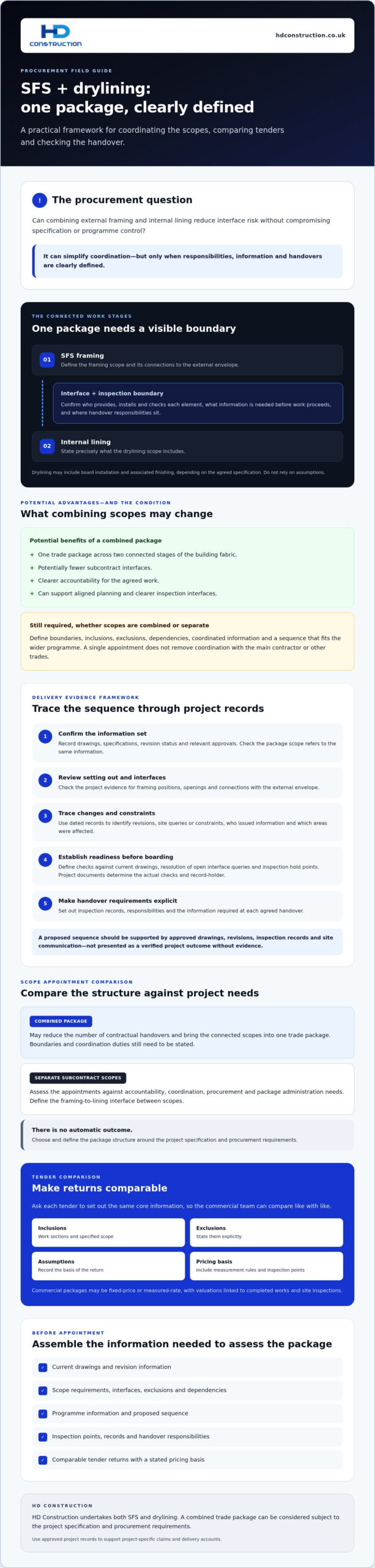
What buyers should check before appointing an SFS and drylining subcontractor
A comparable tender starts with a consistent information set. Issue the same current drawings, specifications, programme details and relevant site constraints to each bidder, then ask them to price and plan against an agreed scope. This makes differences in assumptions visible before appointment, rather than leaving them to emerge at a trade interface.
Tender information that makes proposals comparable
Ask each tenderer to identify inclusions, exclusions and dependencies. Their return should also highlight unresolved design decisions, required information and assumptions that affect sequence or price. Compare fixed-price and measured-rate proposals against the same defined work sections, measurement basis and valuation approach. A headline figure alone will not show whether proposals cover equivalent work.
- Scope: Separate SFS framing, drylining layers and finishing responsibilities, noting openings and interfaces.
- Design information: Confirm drawing and specification revisions, outstanding decisions and information needed before work starts.
- Programme: Check the proposed sequence against the project programme and preceding trade handovers.
- Commercial basis: Record inclusions, exclusions, assumptions, pricing basis and stated dependencies in a common comparison schedule.
Ask bidders how they would coordinate interfaces with the external envelope, partitions and follow-on trades. Their response should identify the information and handover points required, with responsibility assigned rather than left to inference.
Delivery evidence and coordination capability
Request relevant project examples and permission to verify the stated scope. Look for evidence that helps you assess experience with comparable work, rather than relying on broad claims about project scale or outcomes. Review the proposed supervision arrangements, work sequence, inspection points and process for communicating drawing revisions or resolving site queries.
- Ask what records will evidence completed work and any agreed inspection or sign-off stages.
- Check how changes to design information will be identified, communicated and reflected in the scope.
- Confirm the proposed team’s project-specific competence and the documentation available to support the tender response.
- Clarify how each trade handover will be agreed and recorded, including where the subcontractor’s responsibility ends.
Use the same questions and evidence standard for every bidder. This gives the project team a consistent basis for comparing coordination capability alongside scope and commercial terms. HD Construction undertakes commercial SFS and drylining subcontract packages, which may be fixed-price or measured-rate arrangements.
Discuss your SFS and drylining package requirements by sharing the relevant drawings, scope requirements and programme information for review.
How HD Construction can deliver a coordinated SFS and drylining package
HD Construction undertakes both SFS and drylining, so commercial developers and main contractors can consider the company as a single trade-package partner for these scopes. Project documents should determine what is included, how the two workstreams connect and where responsibility passes to other trades. Coordination can be planned around the agreed design information, programme and inspection requirements.
Package terms may be fixed-price or measured-rate. The appropriate basis depends on the defined scope and procurement requirements, and should be assessed against the information available for the project. Valuations are linked to completed works and site inspections, so the proposed package should explain how work sections and inspection records relate to those valuations.
Defining a clear package with HD Construction
A well-prepared scope identifies SFS framing and drylining inclusions separately, then records their shared interfaces. Clarify how openings, lining layers, external-envelope connections and handovers are addressed in the project documents. State exclusions and dependencies too, including outstanding design decisions or information required from others.
HD Construction’s project-based subcontracting for commercial developers and main contractors can be considered against the project’s drawings, specification and procurement approach. Assess a combined appointment against the proposed scope, resourcing and coordination requirements.
Information to prepare for an initial package discussion
To make an initial conversation practical, assemble the information that defines the work and its context. A current, clearly identified document set helps establish what can be assessed and what still needs resolution.
- Current drawings and specifications, including revision status and any available design decisions.
- Programme milestones, proposed sequencing and relevant preceding or follow-on trade handovers.
- Known interfaces, site information and constraints that may affect access or work planning.
- Required inspection points, records and handover information, as stated in the project requirements.
- Procurement preferences, including whether a fixed-price or measured-rate proposal is being considered.
For an SFS and drylining package London, assess the proposal against project-specific documentation rather than general expectations. Sharing the available information helps identify the scope, open questions and practical next steps.
Discuss an SFS and drylining package by outlining the project requirements and sharing the relevant documents for consideration.
Set the scope clearly before moving forward
A coordinated package can bring SFS and drylining into one trade appointment, but its value depends on defined boundaries, clear handovers and project information that supports the proposed sequence. Compare combined and separate scopes against design maturity, procurement needs and the team’s capacity to manage interfaces, rather than assuming one model suits every project.
For an SFS and drylining package London, make inclusions, exclusions, assumptions and inspection requirements explicit in the tender documents. HD Construction undertakes commercial SFS and drylining subcontract packages on a fixed-price or measured-rate basis, subject to the agreed scope and procurement requirements.
Share current drawings, specifications and programme information to establish the project requirements and identify points that need clarification. Discuss your SFS and drylining package with HD Construction to take the next step with a clearly defined scope.
Frequently Asked Questions
What is included in an SFS and drylining package?
Inclusions depend on the project specification and subcontract scope, so packages do not all cover the same work. SFS refers to the steel framing system, while drylining may include boarding, partitions and finishing as specified. Allocate openings, interfaces with other elements, firestopping and making good expressly. Before comparing proposals, check the tender inclusions and exclusions against the drawings, then clarify any work that is assumed or left unassigned.
Is it better to appoint one subcontractor for SFS and drylining?
A combined appointment can give the project team one package interface to manage, but it is not automatically the right option. Consider design maturity, specialist capability, procurement requirements and the team’s capacity to coordinate the work. Separate appointments may suit distinct scopes or procurement needs. Assess the package boundaries and evidence from each tenderer instead of assuming one model will improve programme, cost or delivery.
How should SFS and drylining works be sequenced?
The sequence is project-specific, but typically involves coordinating design information, setting out, installing framing, checking readiness, boarding and completing specified inspections. The approved design, specification and site programme govern the actual order. Agree and record handover points between framing, lining and other work, and resolve relevant interface queries before elements are concealed. Confirm each stage against current project documents rather than assuming a standard duration or sequence applies to every build.
What should a tender for an SFS and drylining package include?
Issue current drawings, specifications, programme requirements and known site constraints to each tenderer. Ask them to state inclusions, exclusions, assumptions, interfaces, proposed sequencing and inspection arrangements. Define the work and measurement basis clearly so fixed-price and measured-rate submissions can be compared on equivalent terms. Clarify unresolved design decisions before treating proposals as like-for-like. This supports a fair tender review, but does not replace project-specific procurement or technical assessment.
How can a buyer verify an SFS and drylining contractor’s experience?
Request relevant project examples and confirm the contractor’s actual scope on each one, distinguishing documented work from general marketing statements. Where references are available, seek permission to contact them. Ask for evidence of coordination, inspection and handover processes relevant to the proposed package, such as sample records or a described approach. Check that the proposed team can address the project’s requirements. Do not infer particular accreditations, approvals or past results without reliable supporting evidence.
Can SFS and drylining be priced as a fixed-price package?
Yes. HD Construction undertakes commercial subcontract packages on fixed-price or measured-rate bases, subject to the defined scope and available project information. Drawings, specifications, assumptions, exclusions and change procedures all affect how a proposal should be assessed. A price cannot be established from a general description alone. For a properly scoped discussion, provide current documents and identify outstanding design decisions, required interfaces and programme information, then review the proposed commercial basis against the agreed scope.