
For tendering for interior fit-out projects in the UK, ISO 9001 and ISO 45001 are the accreditations most commonly required for office fit-out tenders. Buyers may also ask for Constructionline, CHAS or SafeContractor, ISO 14001 and, in some cases, Cyber Essentials. The exact conditions vary by tender, so accreditation is only one part of a compliant, competitive submission.
A strong bid needs to show more than certificates. It should include relevant project evidence, a credible programme, clear cost control and a team prepared to deliver safely, including in occupied or phased environments.
This article explains the accreditations and participation conditions to look for, where framework and project opportunities are advertised, and how tender documents shape a response. It also covers how design, procurement and project management support can align scope, pricing and delivery plans, helping contractors prepare clear bids for interior fit-out and refurbishment contracts.
Key Takeaways
- Match your evidence to the contract: relevant case studies and clear references help demonstrate comparable delivery.
- Build a bid around the tender’s scope, programme and pricing structure, separating work packages where this supports clear comparison.
- Track both framework routes and direct project tenders, then shape each submission around its specific participation conditions.
- Assess value for money through pricing accuracy, delivery planning, experience and quality, not price alone.
Fit-out design, procurement and project management
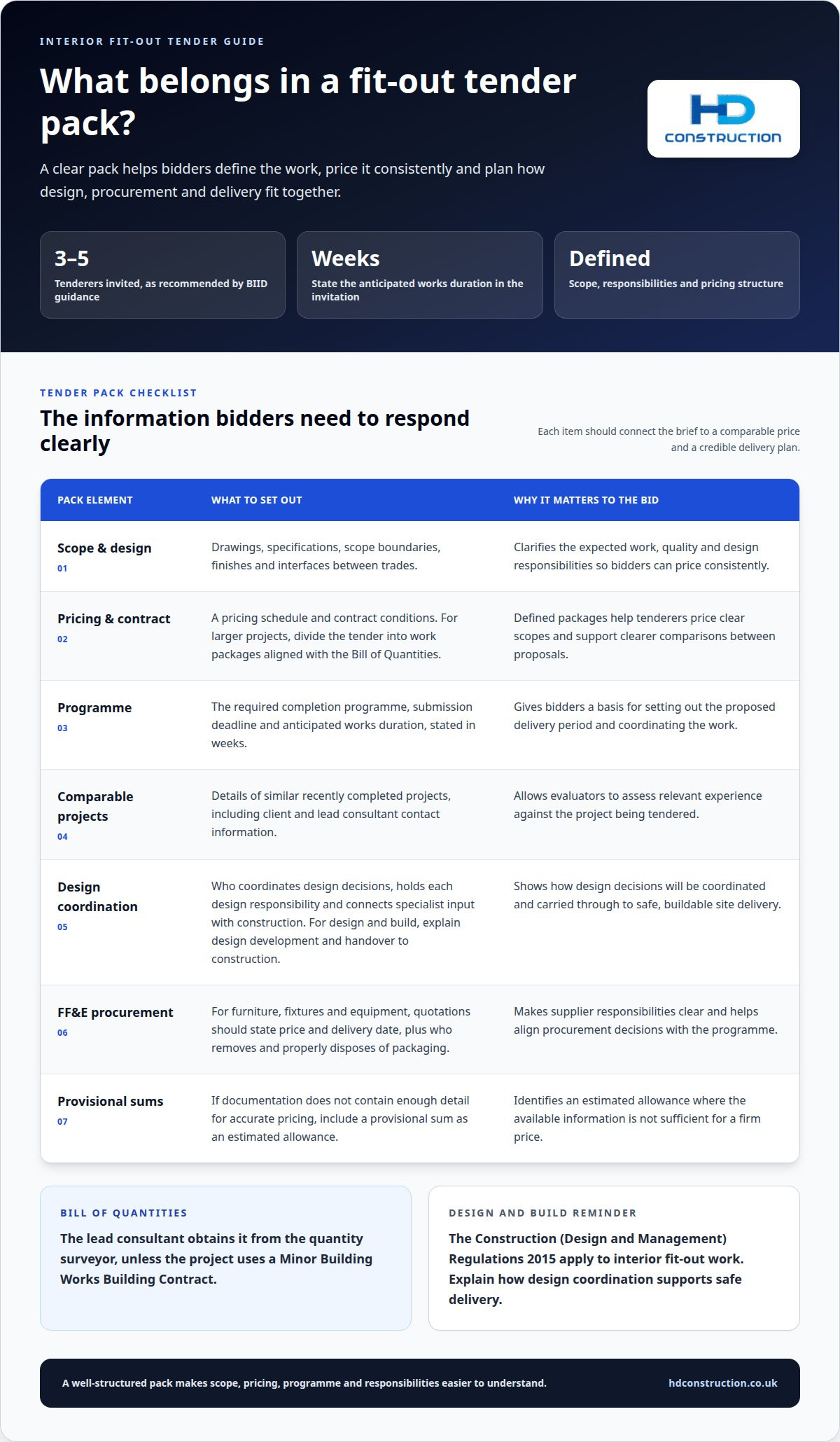
A UK interior fit-out tender pack should define the scope, design information, pricing structure, programme and submission deadline. It should also set out reference requirements and clarify who coordinates design decisions, procurement and delivery. Effective tendering for interior fit-out projects in the UK starts with matching this information to the proposed contract and its responsibilities.
Design and Build Interiors Tenders
Design and build interiors tenders combine design development and construction delivery within one coordinated proposal. The submission should show how the design responds to the brief, who holds each design responsibility, and how specialist input connects with the construction programme. The Construction (Design and Management) Regulations 2015 apply to interior fit-out work. Tenderers should explain how design coordination supports safe, buildable delivery and how design decisions will be carried through to site.
Interior Fit-out Tender Pack Information
Include drawings, specifications, scope boundaries, a pricing schedule, contract conditions and the required completion programme. BIID tender guidance says invitations should state the submission deadline and request the anticipated works duration in weeks. It also recommends requesting details of similar recently completed projects, including client and lead consultant contact information, so evaluators can assess relevant experience.
For larger projects, divide the tender into work packages aligned with the Bill of Quantities. This helps tenderers price defined scopes and supports clearer comparisons. If the documentation lacks enough detail for accurate pricing, include a provisional sum as an estimated allowance. The lead consultant obtains a Bill of Quantities from the quantity surveyor unless the project uses a Minor Building Works Building Contract.
Designers prepare coordinated drawings and specifications, define finishes and identify interfaces between trades. Their information should clarify the scope, quality expectations and design responsibilities so bidders can price consistently. For design and build procurement, tenderers should explain how they will develop the design and manage its handover into construction.
Interior procurement also covers furniture, fixtures and equipment, often shortened to FF&E. Quotations should state the price and delivery date, then outline responsibilities such as removing and properly disposing of packaging. For tendering on interior fit-out projects in the UK, clear procurement responsibilities help align supplier decisions with the programme. BIID guidance recommends inviting 3-5 tenderers, supporting a structured comparison of proposals.
Can you help us win public sector fit-out and refurbishment frameworks?
Public-sector interior fit-out tenders follow the requirements published in each notice and its tender documents. Opportunities may be competed through a framework mini-competition or procured through a consultant framework lot. The Procurement Act 2023 allows suppliers to be excluded for certain criminal convictions, insolvency or failure to pay tax.
Start by identifying the procurement route and the buyer’s timetable. Public-sector construction and refurbishment frameworks include CCS, Pagabo, LHC and Fusion21. Separate opportunities also appear as direct project tenders, while private-sector work can come through developer and landlord frameworks or property panels. Each route has its own participation conditions and submission process.
Public-sector procurement represents a substantial market across goods, works and services. That figure is not specific to fit-out, so a bid still needs to match the scope and buyer requirements. Tender documents may set minimum insurance cover, assess financial standing and request a portfolio of comparable projects.
Build the programme backwards from the submission deadline and planned works period. Allow time for design coordination, approvals, procurement and mobilisation, then show dependencies between these stages. For occupied premises, explain how phasing affects access and sequencing. Procurement lead times depend on the specified items, approval points and delivery arrangements, so state assumptions and decision dates clearly.
Account for procurement fees through the commercial terms stated for the relevant framework or tender. Include any applicable charges in the bid model and distinguish them from project delivery costs. In Scotland, Scottish Procurement describes Meet the Buyer events as a route to learn about upcoming public-sector projects, contracts, frameworks and supply-chain opportunities. Clear project coordination can help connect procurement decisions with the delivery programme.
How do fit-out and interiors contractors win work through tenders?
UK interior fit-out opportunities appear on Find a Tender, Contracts Finder and private framework portals. Strong bids align delivery evidence, pricing and social value commitments with each buyer’s published evaluation criteria.
Contractor Selection and Value for Money
Selection is not simply a contest for the lowest price. Buyers assess pricing errors and omissions alongside the programme, relevant experience and quality of work. Connect each cost to the tender scope and explain how the proposed delivery approach meets the client’s requirements. Case studies should demonstrate comparable work, with evidence relevant to the building type and operating conditions.
Health and safety is also part of a credible delivery proposal. Explain how responsibilities, site controls and coordination will be managed, using evidence relevant to the work being tendered. A well-structured response helps evaluators understand what is included, how risks are addressed and where costs sit. This makes it easier to assess value for money against quality and programme, rather than headline price alone.
Finding Interior Fit-out Tender Opportunities
Use Find a Tender for higher-value UK contracts and Contracts Finder for public-sector notices. Other routes include private framework portals, developer and landlord frameworks, managing-agent panels and direct project tenders. Search using terms that match the scope, such as interior fit-out, refurbishment and workplace works, then review each notice’s deadlines and participation conditions.
Social value is a scored element in public procurement. Most public-sector office fit-out tenders set a mandatory minimum weighting of 10%, so commitments need to be specific and deliverable. TOMs, or Themes, Outcomes and Measures, can help structure those commitments: identify the relevant theme, state the intended outcome, and describe how delivery will be measured. Keep proposed measures proportionate to the project and explain who is responsible for reporting progress. This gives the buyer a clearer basis for comparing social value alongside quality, programme and price.
Common interior fit-out and refurbishment contracts
Interior fit-out contracts cover varied scopes, from a single-floor refurbishment to a multi-stage building development. Tender notices may seek complete design and fit-out, alterations to existing spaces or defined specialist work packages. The contract structure affects pricing, coordination between trades and delivery planning, so match the bid method to the stated scope.
Recent UK examples show this range. The University of South Wales sought a Cardiff Campus relocation and fit-out, with works planned from 1 February to 25 June 2027. Guy’s and St Thomas’ NHS Foundation Trust’s Evelina Expansion involves fitting out 8 floors of a new building. The National Trust’s Saltram opportunity combines interpretation design, supply and fit-out, bringing several delivery stages into one tender.
Refurbishment contracts involve work in an existing building, while new-build fit-outs begin within a developing structure. Tender documents should clarify what will be retained, altered or newly installed, and identify dependencies between contractors. For occupied premises, phasing and access arrangements shape the programme. For new developments, coordination with the wider construction sequence is central to a workable submission.
Read the notice to establish whether the buyer seeks a main contractor, a specialist package or a combined design-and-delivery proposal. Then map the scope against the required evidence, programme and pricing format. A defined package can suit contractors with focused trade capability; a broader contract requires clear responsibility for coordinating design, procurement and interfaces. Social value commitments should reflect the project and the buyer’s stated evaluation method.
For a tender involving interior construction packages, discuss your fit-out tender requirements and how the scope can be aligned with delivery.
HD Construction
HD Construction supports contractors pursuing interior fit-out work with specialist construction packages and coordinated delivery. Its Drylining, Plastering, SFS (Steel Framing System) and Taping & Jointing services can form part of a defined tender scope, helping bidders describe the work clearly.
Turn to HD Construction when a new development or refurbishment requires these interior construction trades. Clear package boundaries help align the proposed work with the tender documents’ drawings, programme and responsibilities. This gives contractors a practical basis for presenting the scope and coordinating interfaces with other work packages.
For a tender that includes these trades, contact HD Construction to discuss the project scope.
Put your next bid into action
A disciplined approach to tendering for interior fit-out projects in the UK starts before the invitation arrives. Keep project evidence, team information and delivery methods organised, then tailor each response to the buyer’s scope and evaluation criteria. This preparation helps focus bid effort on suitable opportunities and present a coherent plan from submission through delivery.
For a tender that includes interior construction work, define package boundaries early and coordinate them with the wider project team. HD Construction’s Drylining, Plastering and SFS (Steel Framing System) expertise can support relevant fit-out scopes and provide a clear basis for planning trade interfaces.
Discuss your next tender with HD Construction and take a considered next step towards a well-structured bid.
Frequently Asked Questions
What accreditations do I need for office fit-out tenders?
ISO 9001 and ISO 45001 are the accreditations most commonly required for office fit-out tenders. Buyers may also request Constructionline, CHAS or SafeContractor, ISO 14001, and sometimes Cyber Essentials. Public-sector procurement may require SSIP certification. Treat the tender’s conditions of participation as decisive: requirements vary, and a buyer may specify particular evidence, insurance or supplier checks.
Do you support Cat A, Cat B and design and build fit-out?
HD Construction supports interior fit-out work, including Design & Build. Cat A typically covers a landlord’s base fit-out, while Cat B adapts the space to an occupier’s needs, including its layout and finishes. The tender scope determines which trades and responsibilities are included. For example, a bid may define a specific interior package within a wider Cat B project.
How much does a commercial fit-out cost?
A commercial fit-out price depends on the project and is provided after a quotation request. The scope, floor area, existing building condition, specification, access arrangements and programme all influence the price. A defined package, such as internal partitions and finishing, is assessed differently from a wider Design & Build project. Compare quotations against the same scope and inclusions to understand the differences.
Should I attend the site visit even if I am confident about the specification?
Yes. A site visit can reveal practical conditions that drawings and specifications do not show clearly. Check delivery access, material routes, storage space, interfaces with existing services and any occupied areas. For example, restricted access may affect how materials reach the workface. Record relevant observations and include their implications in your methodology and programme, following the visit arrangements set out in the tender.
What is the difference between CAT A and CAT B?
Cat A generally describes the landlord’s base fit-out, providing a prepared space for an incoming occupier. Cat B refers to occupier-specific work, such as internal layouts, finishes and features tailored to how the organisation uses the space. The boundary varies by project, so tender documents should identify which elements are complete and which remain within the contractor’s scope.
How does the tendering process work for interior fit-out projects in the UK?
The buyer issues a notice or invitation with the scope, submission requirements and evaluation approach. Interested contractors assess the documents, prepare a compliant bid and submit it by the stated deadline. The buyer then evaluates submissions against its published criteria before awarding the contract. For example, a response may need to explain its methodology alongside its commercial offer, rather than provide only a total price.