
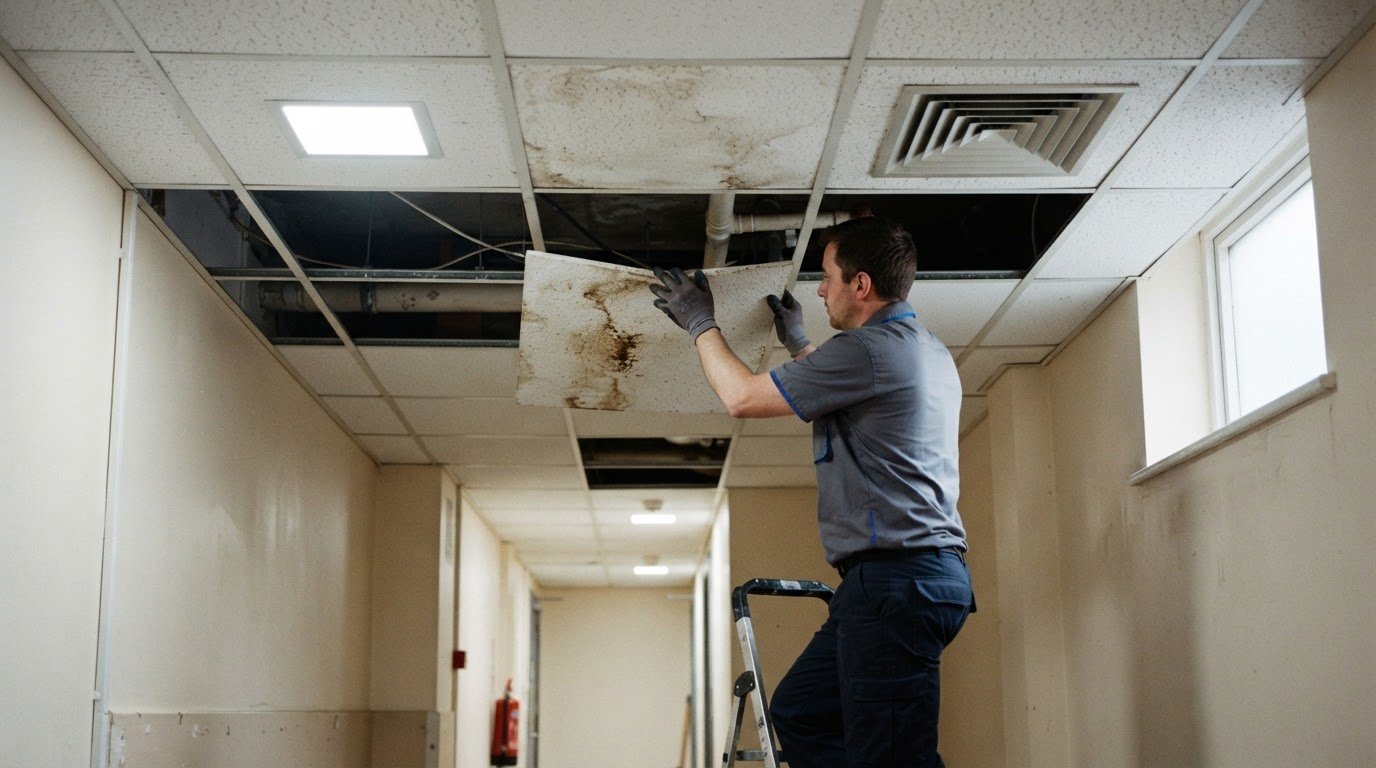
Routine maintenance keeps a suspended ceiling serviceable, not just presentable. This suspended ceiling maintenance guide explains why inspections matter: in many commercial environments, checking the ceiling every few months is sensible. Set the frequency according to how the space is used, its environment and the system installed.
It’s easy to focus on visible tiles, but the grid, lighting and ventilation also need attention. Damage, staining, sagging or misalignment can indicate that a component needs repair or replacement. A stain may point to an underlying leak that needs addressing first.
Read on to learn how to assess each part of the ceiling, recognise signs that need further attention and decide when an individual tile replacement may be appropriate. A consistent inspection routine helps identify issues early and supports a sound, well-presented ceiling system.
Key Takeaways
- Use stains, sagging and visible damage to identify tiles that may need attention, while tracing moisture back to its source.
- Include integrated lighting and ventilation in routine checks, looking for visible damage and components that are no longer secure.
- Look for changes in grid alignment and levelness, as these can indicate that the ceiling needs a closer assessment.
- Set an inspection routine around the space, its use and the ceiling system to help catch developing issues early.
When Should You Replace Ceiling Tiles?
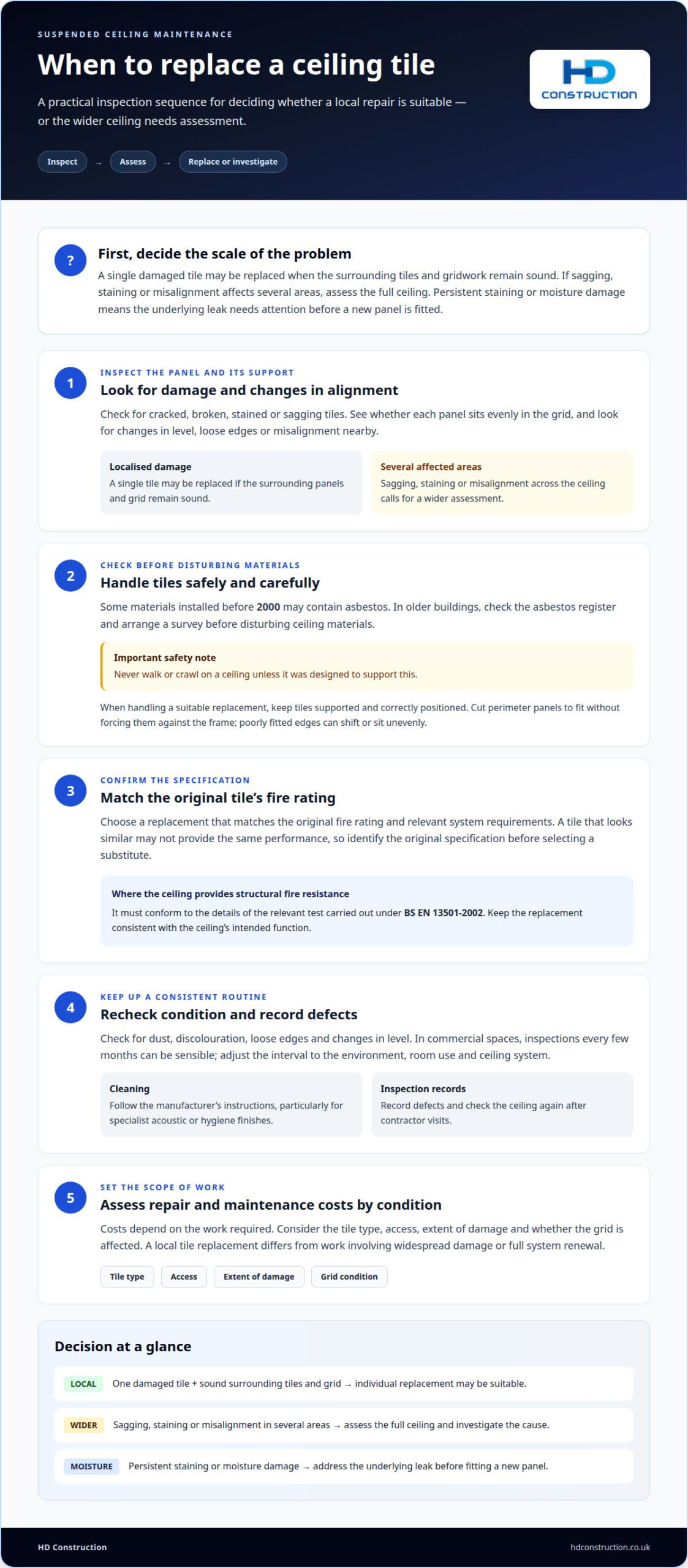
Replace individual tiles when damage is localised and the grid remains sound. Assess the full ceiling if sagging, staining or misalignment affects several areas.
-
Inspect Tiles and Grid Alignment
Look across the ceiling for cracked, broken, stained or sagging tiles, then check whether each panel sits evenly within its grid. A single damaged tile may be replaced without renewing the complete system if the surrounding tiles and gridwork remain sound. Persistent staining or moisture damage requires attention to the underlying leak before fitting a new panel. Record defects and check the ceiling again after contractor visits.
- Remove and place tiles carefully, keeping them supported and correctly positioned in the grid. Cut perimeter panels to fit without forcing them against the frame; poorly fitted edges can shift or sit unevenly. Some materials installed before 2000 may contain asbestos. In older buildings, check the asbestos register and arrange a survey before disturbing ceiling materials. Never walk or crawl on a ceiling unless it was designed to support this.
-
Match Replacement Tiles to Fire Ratings
Choose replacement panels that match the original tiles’ fire rating and relevant system requirements. A visually similar tile may not provide the same performance, so identify the original specification before fitting a substitute. Where the suspended ceiling is intended to provide structural fire resistance, it must conform to the details of the relevant test carried out under BS EN 13501-2002. Keep the replacement consistent with the existing ceiling’s intended function.
- Check tiles regularly for dust, discolouration, loose edges and changes in level. Cleaning methods depend on the tile and its environment, so check the manufacturer’s instructions before using products, particularly on specialist acoustic or hygiene finishes. In commercial spaces, inspections every few months can be sensible. Adjust the interval to the environment, room use and ceiling system.
In the UK, the Health & Safety at Work Act cited by this guide is the Health & Safety at Work Act 1974, according to The National Archives (legislation.gov.uk).
-
Consider Repair and Maintenance Costs
In the UK, suspended ceiling repair and maintenance costs depend on the work required, including tile type, access, the extent of damage and whether the grid is affected. The price depends on the case and is given after a quote request. A local tile replacement differs from work involving widespread damage or a full system renewal, so assess the condition before deciding the scope.
Checking integrated lighting and ventilation
Inspect lighting and ventilation alongside the ceiling, recording visible faults and changes in operation. A routine check should identify issues without disturbing fittings or ceiling components.
- Walk the room and check every integrated light for visible damage, movement or a gap around its fitting. Integrated suspended-ceiling lighting should remain secure and show no visible damage. Note cracked covers, loose-looking edges, discolouration or fittings that sit differently from neighbouring lights. Record each position, such as above a meeting table, so the issue can be located for repair.
- Compare the lights during normal operation, noting any that fail to illuminate, flicker or appear noticeably different from adjacent fittings. Record the affected location and whether the issue is consistent or intermittent. Avoid opening fittings or disturbing ceiling tiles to investigate electrical components. This visual and operational record helps distinguish a local lighting fault from a wider ceiling concern.
- Inspect each ventilation grille for visible damage, loose edges, dust build-up or obstruction. Check that it remains aligned with the surrounding tile and has not shifted within the grid. A bent or partly detached edge can indicate that the fitting or its support needs attention. Do not remove the grille during a routine visual inspection.
- Observe ventilation during normal use and note changes in airflow, unusual noise or persistent condensation near a grille. Compare similar rooms or grilles serving the same space, recording where any difference occurs. Keep the observation specific: identify a noisy grille above a particular workstation rather than describing the whole room as affected.
- Document each finding by room, fitting location and visible symptom, then compare it with earlier inspection records. Recheck whether the light remains secure and whether the grille or surrounding tile has shifted. If contractor work has taken place above the ceiling, include the affected area in the inspection. These records support a clear decision about whether further assessment or repair is needed.
Damaged or misaligned ceiling grids
Assess the grid before treating a displaced tile as an isolated fault. Use these steps to record visible movement and identify when specialist work is needed.
- Scan the ceiling from several positions, looking for uneven lines, bowed runners, gaps at joints and tiles that sit proud or low. Compare neighbouring grid sections to see whether the change is local or continues across the room. Record the affected area and any nearby impact marks, water staining or fittings that may have shifted with the grid.
- Check levelness against the installation tolerances stated under BS EN 13964 : 2004: no more than 2mm per metre and no more than 5mm over 5m, measured horizontally at suspension locations. The same standard specifies a maximum flatness deviation of 5mm over a 5m length. Treat visible distortion as a reason for closer assessment, not an invitation to force runners back into position.
- Look for loose, bent or disconnected grid members, including main runners and cross tees. Note whether a damaged section supports several tiles or sits near a light or ventilation grille. This helps show whether the issue affects one component or a wider area. Keep the inspection visual; don’t lift multiple panels or alter hangers to expose the ceiling void.
- Distinguish a simple tile replacement from work involving the grid, hangers or suspension points. Beyond a quick tile swap, leave ceiling work to trained contractors using suitable access equipment. Only suitably trained operatives should adapt hangers or associated gridwork, because changes can lead to ceiling collapse. Keep people clear of visibly unstable sections until they can be assessed.
- Record the location, length and appearance of each damaged section, then compare those notes during later inspections. If movement returns after a tile is repositioned, or several grid lines appear uneven, treat the pattern as a system issue rather than repeatedly adjusting individual panels. A clear record helps define the repair scope and preserves the original grid layout as a reference.
Why routine suspended ceiling maintenance matters
Use a suspended ceiling maintenance guide to establish a planned routine instead of relying on faults being reported. Set inspection frequency according to the building’s environment, room use and ceiling system; checks every few months can be sensible in many commercial settings. An annual review also provides a consistent point for assessing changes across the building.
- Record the condition of tiles, grid lines, lighting and ventilation at each inspection. Note the location and appearance of defects, then compare them with previous records. For example, tracking a recurring mark in the same office area can help identify a persistent issue. A clear history supports decisions about whether to focus attention on one component or a wider area.
- Respond promptly when moisture, staining or impact damage appears. Water can make mineral fibre tiles heavier and cause them to sag, so identify and address the source before replacing a panel. After contractor visits, inspect the affected ceiling area and check that components remain in position and haven’t been disturbed.
- Plan safe access before work above or around the ceiling. In the UK, the Health & Safety at Work Act cited here is the Health & Safety at Work Act 1974, according to The National Archives (legislation.gov.uk). Beyond a quick tile swap, ceiling work should be left to trained contractors with suitable access equipment. Hangers and gridwork should only be adapted by suitably trained operatives.
- Use inspection records to prioritise maintenance and track completed work. A well-maintained suspended ceiling can last for decades, with its condition shaped by the environment and care it receives. Keep a suspended ceiling maintenance guide alongside site records so inspection findings and follow-up work remain organised. For planned ceiling-system work, discuss your ceiling system requirements as a next step.
HD Construction: Ceiling Systems
HD Construction delivers Ceiling Systems for projects where damaged grids, recurring tile issues or wider refurbishment call for planned ceiling work. Its scope also includes drylining, plastering and SFS (Steel Framing System), supporting coordinated interior construction when these elements form part of the same project.
Turn to HD Construction when inspections indicate that replacing a single tile is not enough, or when a ceiling system needs to form part of a broader fit-out. Clear records of damaged areas, grid movement and affected fittings help define the work required and support a practical project discussion.
For ceiling-system work based on your maintenance findings, contact HD Construction to discuss your project.
Plan the next step for your ceiling
Use this suspended ceiling maintenance guide to turn inspection notes into a clear maintenance plan. Group findings by location and urgency, then distinguish routine monitoring from work that needs a coordinated repair. This gives your facilities team a practical record for future maintenance planning.
Where the required work extends beyond ceiling panels, HD Construction also offers Drylining, Plastering and SFS (Steel Framing System). These services can support a wider interior construction project, helping define a coordinated scope around the building’s requirements.
Share your project requirements with Contact HD Construction to discuss the appropriate next step. A clear scope gives the work a sound starting point.
Frequently Asked Questions
Why is suspended ceiling maintenance important?
Routine checks help teams spot developing faults before they spread across a room or disrupt its use. For example, record a new stain by room and position, then compare it during the next inspection. This creates a useful maintenance history, supports decisions about repair scope and helps distinguish a recurring problem from an isolated defect.
Repair or replacement?
Repair is usually appropriate when the fault is limited and the surrounding ceiling remains sound. A single damaged panel, for example, can often be replaced without renewing the complete system. Wider damage, persistent sagging or repeated faults may call for a broader assessment. Consider tile condition, grid stability, the source of damage and the ceiling’s fire performance.
How do you clean suspended ceiling tiles without damaging them?
Use only a cleaning method suited to the tile’s material and finish. Check the manufacturer’s instructions before applying any product, especially to specialist acoustic or hygiene finishes. Where guidance permits, some tiles can be cleaned with a lightly damp cloth. Avoid soaking panels or scrubbing their surface, as excess moisture or abrasion may affect the tile’s appearance and condition.
How do you replace a damaged suspended ceiling tile?
First identify a compatible replacement, including a matching fire rating, then remove the damaged panel without forcing the surrounding grid. Place the new tile squarely into the opening and check that it sits level with adjacent panels. In older buildings, check the asbestos register and arrange a survey before disturbing materials that may contain asbestos.
How do you inspect and repair suspended ceiling grid and hangers?
Look for bowed runners, displaced cross tees, uneven lines and tiles that no longer sit flush. Note the location and extent of each visible change, then keep people clear of unstable sections. Work beyond a quick tile swap should be handled by trained contractors using suitable access equipment. Only suitably trained operatives should alter hangers or gridwork.
What are signs of water damage, mould or corrosion in a suspended ceiling?
Water damage may appear as staining, discolouration, soft or sagging tiles, or repeated marks in the same area. Look for visible mould-like patches and corrosion, such as rust-coloured marks or flaking metal on grid components. These signs warrant investigation of the affected area and possible moisture source. Replacing a stained panel alone won’t address an unresolved leak.