HD Construction

From chippies to brickies: The construction slang of the UK building trade

Ever wondered what tradespeople are actually saying on site? UK construction has its own shorthand, packed with nicknames and phrases that help keep communication fast, clear and efficient across busy building projects.

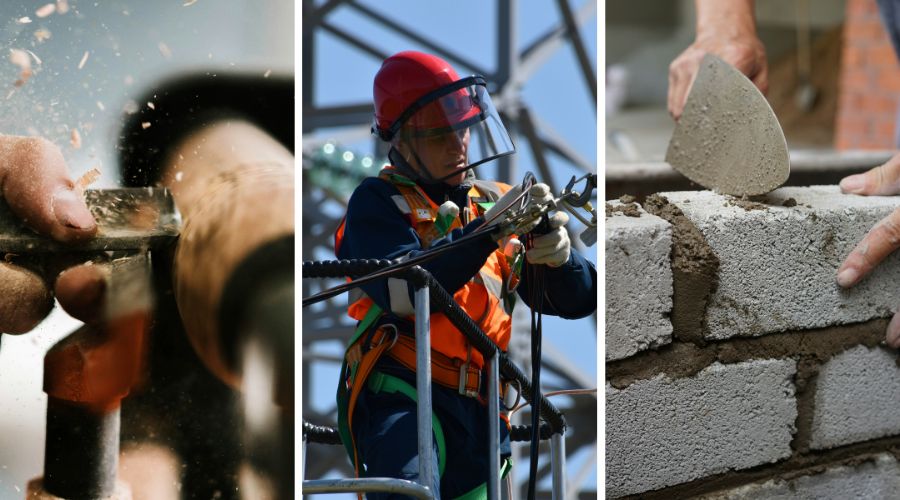
Credit L-R: Austin Ramsey / Anton Dmitriev / Solømen. All Unsplash.

Much of this language is rooted in the realities of site work. Some terms come from the tools being used, others from materials, sounds or conditions on the job. Many have been passed down through generations of trades and have become everyday language across the UK construction industry.

Some of the best-known examples are still heard on sites across the country today – and many have surprisingly long histories, with some traced as far back as the 16th century. Let’s take a look…

Sparky – An electrician. Linked to the sparks produced during electrical work, with recorded use dating back to the early 20th century, including a 1920s reference in the New Zealand Truth newspaper.

Chippy – A carpenter or joiner working with timber and fittings. The term comes from the wood chips produced when shaping timber with tools such as chisels, saws and planers, and is thought to date back to carpenters working aboard ships in the 18th century.

‘Some of the best-known examples are still heard on sites across the country today – and many have surprisingly long histories, with some traced as far back as the 16th century.’

Brickie – A colloquial shortening of bricklayer. The nickname originated in the mid-19th century in both the UK and Australia, with early recorded use in Australia’s Port Phillip Gazette in 1847, the second newspaper published in Melbourne. It was used to describe tradespeople skilled in laying bricks, pre-cut stone and concrete blocks.

Pipefitter – A tradesperson who installs and fits pipe systems, broadly similar to a plumber. The term was first recorded in 1860 in the writing of author G. W. Hawes, who used it to describe the trade, marking one of the earliest known written uses of the word.

Gaffer – The site manager or supervisor in charge of operations. The term comes from an old English word meaning an elderly man or respected leader, in use as far back as the 1500s, with early written references appearing in works of clergy and playwright William Stevenson.

SPONSORED CONTENT by CHIME

Champion Groundworks have removed 100’s of phone calls and paper timesheets with a move to digital. Read More

The language doesn’t stop at job titles. Everyday site activity has its own shorthand, with processes and materials often shortened into quick, widely understood terms.

If someone mentions first fix, they mean the work completed before plastering, such as wiring and pipework, while second fix refers to the finishing stage, including sockets and fittings. Before handover, workers carry out snagging to fix minor defects, while dot and dab describes fixing plasterboard to masonry with adhesive.

Materials have their own vocabulary too. Muck is mortar, screed is the concrete layer that levels a floor, skim is the final coat of plaster, and render – typically made from sand, water, cement and lime – is the external coating applied to walls. Lagging simply means pipe insulation, while eggshell is a paint finish between matt and gloss.

Structural terms are just as distinctive. A joist supports a floor or ceiling, flashing is the metal used to waterproof roof and wall junctions, and a party wall separates adjoining properties.

Credit:
Marina Nazina/Unsplash.

While informal, this language is widely understood across the industry and helps keep communication fast and effective on busy UK building sites.

And don’t forget the builder’s tea – a strong, quick-brewed black tea that became a staple of UK construction and manufacturing in the mid-to-late 20th century. Typically served with milk and sugar, it was designed to deliver a fast caffeine hit on busy UK sites.

Have we missed any? Let us know – please keep suggestions suitable for publication.

Was this interesting? Try: Why construction’s next generation of CEOs are coming from finance

If you have a tip or story idea that fits with our publication, please contact danielle@wavenews.co.uk

Get industry news in 5 minutes!

A daily email that makes industry news enjoyable. It’s completely free.

Notice: JavaScript is required for this content.

Ever wondered what tradespeople are actually saying on site? UK construction has its own shorthand, packed with nicknames and phrases that help keep communication fast, clear and efficient across busy building projects.

Credit L-R: Austin Ramsey / Anton Dmitriev / Solømen. All Unsplash.

Much of this language is rooted in the realities of site work. Some terms come from the tools being used, others from materials, sounds or conditions on the job. Many have been passed down through generations of trades and have become everyday language across the UK construction industry.

Some of the best-known examples are still heard on sites across the country today – and many have surprisingly long histories, with some traced as far back as the 16th century. Let’s take a look…

Sparky – An electrician. Linked to the sparks produced during electrical work, with recorded use dating back to the early 20th century, including a 1920s reference in the New Zealand Truth newspaper.

Chippy – A carpenter or joiner working with timber and fittings. The term comes from the wood chips produced when shaping timber with tools such as chisels, saws and planers, and is thought to date back to carpenters working aboard ships in the 18th century.

‘Some of the best-known examples are still heard on sites across the country today – and many have surprisingly long histories, with some traced as far back as the 16th century.’

Brickie – A colloquial shortening of bricklayer. The nickname originated in the mid-19th century in both the UK and Australia, with early recorded use in Australia’s Port Phillip Gazette in 1847, the second newspaper published in Melbourne. It was used to describe tradespeople skilled in laying bricks, pre-cut stone and concrete blocks.

Pipefitter – A tradesperson who installs and fits pipe systems, broadly similar to a plumber. The term was first recorded in 1860 in the writing of author G. W. Hawes, who used it to describe the trade, marking one of the earliest known written uses of the word.

Gaffer – The site manager or supervisor in charge of operations. The term comes from an old English word meaning an elderly man or respected leader, in use as far back as the 1500s, with early written references appearing in works of clergy and playwright William Stevenson.

SPONSORED CONTENT by CHIME

Champion Groundworks have removed 100’s of phone calls and paper timesheets with a move to digital. Read More

The language doesn’t stop at job titles. Everyday site activity has its own shorthand, with processes and materials often shortened into quick, widely understood terms.

If someone mentions first fix, they mean the work completed before plastering, such as wiring and pipework, while second fix refers to the finishing stage, including sockets and fittings. Before handover, workers carry out snagging to fix minor defects, while dot and dab describes fixing plasterboard to masonry with adhesive.

Materials have their own vocabulary too. Muck is mortar, screed is the concrete layer that levels a floor, skim is the final coat of plaster, and render – typically made from sand, water, cement and lime – is the external coating applied to walls. Lagging simply means pipe insulation, while eggshell is a paint finish between matt and gloss.

Structural terms are just as distinctive. A joist supports a floor or ceiling, flashing is the metal used to waterproof roof and wall junctions, and a party wall separates adjoining properties.

Credit:
Marina Nazina/Unsplash.

While informal, this language is widely understood across the industry and helps keep communication fast and effective on busy UK building sites.

And don’t forget the builder’s tea – a strong, quick-brewed black tea that became a staple of UK construction and manufacturing in the mid-to-late 20th century. Typically served with milk and sugar, it was designed to deliver a fast caffeine hit on busy UK sites.

Have we missed any? Let us know – please keep suggestions suitable for publication.

Was this interesting? Try: Why construction’s next generation of CEOs are coming from finance

If you have a tip or story idea that fits with our publication, please contact danielle@wavenews.co.uk

Get industry news in 5 minutes!

A daily email that makes industry news enjoyable. It’s completely free.

Notice: JavaScript is required for this content.

Leave a Reply

Your email address will not be published. Required fields are marked *

Select the fields to be shown. Others will be hidden. Drag and drop to rearrange the order.
  • Image
  • SKU
  • Rating
  • Price
  • Stock
  • Availability
  • Add to cart
  • Description
  • Content
  • Weight
  • Dimensions
  • Additional information
Click outside to hide the comparison bar
Compare