

The broadest tender return is not always the safest appointment. For an interior fit-out subcontractor tier 1 project, a detailed price is only useful when every bidder has priced the same scope, with the same trade interfaces and delivery responsibilities.
Unclear boundaries can affect programme, workmanship and commercial accountability once site activities begin. A capability statement alone does not show how a subcontractor will sequence work, coordinate package boundaries or manage delivery on a live project. Comparing submissions against consistent, project-specific criteria gives teams a clearer basis for choosing.
This guide sets out a practical way to assess scope, delivery controls and commercial fit before appointment. It covers how to define responsibilities between trades, review evidence of delivery and compare fixed-price or measured-rate packages against project requirements. HD Construction delivers defined trade packages across drylining, SFS, ceiling systems and other interior construction scopes. The aim is to select a delivery partner whose responsibilities and approach match the programme, site conditions and required standard of work.
Key Takeaways
- Define the trade package and its boundaries so responsibilities are clear before tender evaluation.
- Compare each interior fit-out subcontractor tier 1 tender against the same drawings, specifications and submission requirements.
- Assess proposed supervision, sequencing, quality checks and site coordination, not just capability statements.
- Record exclusions, assumptions and dependencies before comparing fixed-price or measured-rate submissions.
- Use a structured procurement process to align package information and project milestones before appointment.
What Tier 1 teams need from an interior fit-out subcontractor
A specialist subcontractor delivers an agreed trade package within the main contractor’s wider project. The package may cover defined elements such as drylining, SFS, ceiling systems or firestopping. Tender documents and the appointment set out the precise inclusions. The work must also fit the surrounding sequence: substrates need to be ready, adjoining trades need access, and completed areas must be handed over for follow-on activities.
This differs from appointing a principal contractor or choosing a procurement framework. A subcontractor is responsible for its appointed package, not the overall construction project or the procurement route. The wider construction process involves multiple roles and activities, as outlined in this Construction industry overview. For Tier 1 teams, the practical test is whether the package can be delivered within the agreed boundaries, programme and site requirements.
What does an interior fit-out subcontractor deliver on a Tier 1 project?
Delivery typically means installing and finishing the specified trade elements to the required drawings and specification. For example, a drylining package may need to coordinate with the SFS structure, service penetrations and ceiling installation. The subcontractor is responsible for the work expressly assigned to its package. Other trades may retain responsibility for preparation, access, connections or making good. Tender documents and appointment terms define these boundaries, so resolve assumptions before work starts.
Why capability statements alone are not enough
A list of trades shows the range of a subcontractor’s work, but not how it will plan and manage a specific package. Look for project-relevant detail on sequencing, supervision, quality checks, coordination and reporting. Defined responsibilities help the main contractor identify who completes each activity, when interfaces need attention and how issues are raised. This gives a clearer basis for accountability than a general claim of broad capability.
Scope clarity matters at trade interfaces. If ceiling installation depends on completed services or inspected firestopping, the sequence and handover points need to be clear to everyone involved. Without defined boundaries, a task may be left unowned or two trades may assume the other is responsible. Assess both trade competence and the proposed approach to the actual project.
Suitability depends on the package. A subcontractor may suit one scope but be less suited to another with different access constraints, phasing or coordination demands. Compare the proposed work with the project drawings, specification, programme and site arrangements before appointment. HD Construction delivers project-based interior trade packages, including drylining, SFS and ceiling systems. Its commercial interior fit-out scope and delivery explains how defined work packages relate to project readiness and coordination.
How to compare interior fit-out subcontractor capability and package scope
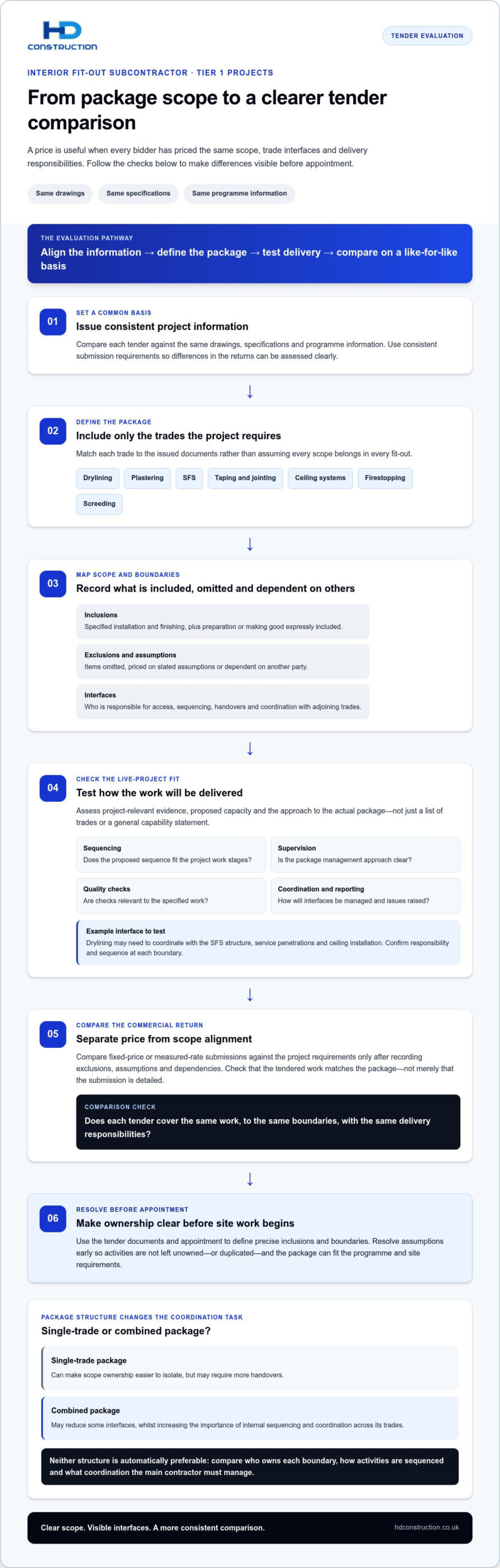
Start with a package comparison matrix, not a general count of services offered. Record what each tender includes, excludes and relies on others to provide, then check each entry against the same drawings, specifications and programme information. This makes differences visible before they become gaps, duplicated work or disputed responsibilities on site.
Trade scope: Drylining, plastering, SFS, taping and jointing, ceiling systems, firestopping or screeding, as required by the project.
Inclusions: The specified installation and finishing, plus any preparation or making good expressly included.
Exclusions and assumptions: Items omitted, dependent on others or priced on stated assumptions.
Interfaces: Responsibility for access, sequencing, handovers and coordination with adjoining trades.
Evidence: Relevant capability, proposed capacity and commercial submission, assessed separately.
Use the matrix to test scope alignment in detail. Check, for example, that the drylining extent matches the drawings and that interfaces with SFS, services and ceilings are addressed. Then compare the proposed sequence with the project’s work stages. A stated capability does not prove that the tender includes every related activity. The tender return and appointment define the package. Where drylining details need closer technical review, consult the guidance on commercial drylining technical specifications.
Which trade scopes belong in the comparison?
Include only trades required by the project scope. A package may combine drylining with taping and jointing, or specify SFS and ceilings separately, while firestopping, plastering or screeding may sit elsewhere. Match each trade to the issued documents rather than assuming every scope belongs in every fit-out. This keeps the evaluation focused on the package and its interfaces.
How to compare single-trade and combined packages
A single-trade package can make scope ownership easier to isolate, but may require more handovers. A combined package may reduce some interfaces while placing greater emphasis on internal sequencing and coordination across its trades. Neither structure is automatically preferable. Compare who owns each boundary, how activities are sequenced and what coordination the main contractor must manage. Where framing is part of the assessment, the overview of SFS construction systems provides additional context.
Keep three judgements separate: capability is relevant trade experience and technical fit; capacity is the proposed resource and ability to meet the required sequence; commercial fit is the submission against the defined scope, exclusions and assumptions. Assessing each separately helps avoid choosing on price or breadth of services alone. HD Construction delivers defined interior trade packages that can be assessed against project boundaries and coordination requirements. See HD Construction’s interior trade packages.
What evidence should you assess before appointing a fit-out subcontractor?
A tender return is useful when its evidence can be checked against the package issued. Review it against the scope, drawings, specifications and submission requirements, noting missing documents as well as qualified answers. For an interior fit-out subcontractor tier 1 appointment, the aim is to understand how the proposed team will deliver this package, not simply to confirm that it offers the relevant trades.
How to review a tender submission consistently
Apply the same evaluation headings and information requirements to every tender. This makes omissions and differences easier to identify, rather than letting presentation style influence the assessment. Keep qualifications, assumptions and exclusions separate from the submitted price. Record each clarification against the relevant drawing, specification clause or scope item so the final position is traceable.
- Scope response: Check that the return addresses the issued package and identifies qualifications or omissions.
- Delivery plan: Review proposed management, supervision, sequencing and coordination.
- Quality controls: Look for planned inspections, checks and records relevant to the specified work.
- Safety and compliance: Review project-specific information and evidence through the appropriate project process.
- Commercial assumptions: Record dependencies and exclusions separately, then resolve their effect on the package.
Apply the same discipline to clarifications. If a response changes an assumption about access or preparation, record the change and assess it against the same package documents used for the other returns. This prevents an informal discussion from being treated as an agreed scope change without a clear record. It also gives the appointment team a reliable basis for carrying the evaluated position into the subcontract documents.
Which delivery controls reduce uncertainty on site?
Check whether the proposed arrangements identify who supervises the work, coordinates with adjoining trades, completes inspections and escalates issues. The plan should relate to the actual sequence: access to work fronts, prerequisites from preceding activities and handovers to follow-on trades. General statements about quality or communication are less useful unless they explain how the controls will operate on this package.
For example, if installation depends on an area being released, the submission should identify that dependency and the required handover. This helps the main contractor plan work fronts and address constraints before they disrupt progress. For firestopping packages, review how installation scope and supporting evidence fit together. The guide to passive fire protection installation and evidence provides related detail.
Treat safety, compliance and quality material as project-specific evidence, not as a generic pass based on a company profile. Check that the documents relate to the proposed scope, sequence and site arrangements, and that responsibilities for maintaining records are clear. This supports a sounder appointment decision and helps turn tender commitments into practical delivery controls.
How to assess commercial fit, interfaces and programme risk
A tender figure is comparable only when it covers the same work on the same basis. Before ranking submissions, align each return with the package scope and record differences in inclusions, exclusions, assumptions and dependencies. Otherwise, a lower initial tender may reflect omitted work or a different allocation of responsibilities, rather than a more efficient delivery approach.
For an interior fit-out subcontractor tier 1 appointment, commercial review should follow scope normalisation. A fixed-price submission and a measured-rate submission may use different pricing bases, so establish what each includes and how the work is measured before comparing them. Keep unresolved qualifications visible. Do not treat an assumption as an agreed responsibility.
How to expose package gaps before award
Build an inclusions and exclusions schedule against the tender documents, noting who owns each activity and what it depends on. Include practical items such as access to work areas, protection of completed work, coordination with adjacent trades and completion evidence. If a return differs materially from the issued scope, raise a documented clarification and record the agreed position before final evaluation.
For example, a package may include installation but exclude preparation of the receiving surface, or depend on another trade completing work before access is available. These points affect both the commercial comparison and the site sequence. Record each gap against the relevant scope item, drawing or specification, then assess whether it changes package boundaries, coordination or completion responsibilities.
How to compare programme and interface commitments
Test the proposed sequence against the main programme, milestones and planned handovers for each work area. Check dependencies such as preceding trade completion, access release and the availability of adjoining work fronts. A programme statement is more useful when it explains these assumptions and shows how the subcontractor will coordinate with site teams and other trades.
A risk-and-responsibility matrix makes the review practical. Record the activity or interface, the responsible party, the dependency, the required decision and the milestone by which it matters. For example, if ceiling installation follows services work, identify who confirms that the area is ready and how incomplete work or delay is raised. This exposes unresolved interfaces before they affect planned progress.
- Package boundary: What work is included, excluded or dependent on another party?
- Programme: Which milestones, access arrangements and handovers does the proposal rely on?
- Interface owner: Who coordinates each shared activity and records its completion?
- Open decision: What needs clarification before appointment or work proceeds?
Use the comparison to distinguish commercial value from risk transfer. A submission with a different scope should not be ranked as if it were like-for-like. Clarify the difference, assess its effect on programme and coordination, then compare the aligned commercial positions. See HD Construction’s interior trade packages in relation to the project scope and delivery requirements.
A practical procurement route for appointing the right subcontractor
A clear procurement sequence helps Tier 1 teams move from a defined requirement to an appointment that reflects the work, programme and commercial basis. Before issuing a package, align the information tenderers will use to prepare their submissions. Include the scope, current drawings and specifications, known interfaces, sequencing assumptions, site constraints and tender-return format. Consistent information makes the comparison more useful.
A five-step sequence from tender issue to appointment
- Define the package. Identify the trades and activities required, the drawings and specifications that govern them, and the boundaries with adjoining packages. Set out known dependencies, access conditions and handover requirements.
- Prepare the tender information. Issue the same documents and return requirements to each tenderer. Explain how to record inclusions, exclusions, assumptions, programme proposals and commercial basis so submissions can be compared consistently.
- Evaluate capability and scope. Compare each return against the issued package. Assess trade fit, proposed supervision and delivery arrangements separately from commercial terms. Record gaps and qualifications rather than treating them as implicit agreement.
- Clarify material differences. Resolve scope, interface and sequencing questions in a traceable way. Update the comparison if a clarification changes an assumption, dependency or allocation of responsibility.
- Agree the appointment position. Before award, align the final scope, commercial basis, programme interfaces and responsibilities in the appointment documents. Carry relevant clarifications into the agreed package information.
This route works best when the information behind the package is aligned before tender issue. For example, if the sequence depends on an area being released after preceding work, identify that dependency and the required handover. If completion evidence forms part of the package, describe what is required and who receives it. Clear tender inputs help each return address the same delivery conditions.
Where HD Construction fits a Tier 1 package requirement
HD Construction delivers project-based trade packages that can include drylining, SFS, plastering, ceiling systems and firestopping. The project documents and package boundaries determine the relevant scope. A requirement may cover one trade or coordinate several related activities. When assessing an interior fit-out subcontractor for a Tier 1 project, compare the defined trade scope, interfaces and programme requirements, not simply the number of services in a capability list.
Packages are tendered on a fixed-price or measured-rate basis. The applicable basis relates to the defined project scope. Aligning the scope and its assumptions allows procurement teams to assess the submission against the work required and carry a clear position into appointment.
For a defined interior trade package, review HD Construction’s services in relation to the project scope and delivery requirements.
Carry a clear appointment into delivery
Procurement does not end at appointment. The agreement sets the working baseline for mobilisation, so carry clarifications, responsibilities and decision points into day-to-day project coordination. This gives the site team a shared reference when conditions change and keeps package commitments visible beyond tender evaluation.
Selecting an interior fit-out subcontractor tier 1 teams can work with starts with a defined requirement and ends with clear accountability. Align the project’s needs with a subcontracting partner equipped to deliver the relevant trade package. HD Construction works with project teams on defined interior construction packages, supporting a considered route from scope discussion to delivery planning.
Discuss your project package with HD Construction to align the required scope and delivery approach.
Frequently Asked Questions
What does Tier 1 mean in UK construction procurement?
In UK construction procurement, “Tier 1” commonly describes a principal or major contractor delivering a project directly for a client, although organisations may use the term differently. For a trade subcontractor, the label matters less than the procurement structure. A tender should set out package responsibilities, reporting routes, programme requirements and expected records so bidders understand the role consistently.
Can a Tier 1 contractor appoint a specialist interior fit-out subcontractor directly?
Yes, a main contractor can appoint a specialist trade subcontractor directly when that approach suits the project and contract structure. For an interior fit-out subcontractor tier 1 appointment, the subcontract should make the work, interfaces, programme obligations, commercial basis and required records clear. For example, identify who coordinates access to each work area and how changes are handled. The appointment model should reflect the project’s procurement strategy, rather than being assumed to apply universally.
Is subcontractor prequalification the same as tender evaluation?
No. Prequalification is an initial check against a buyer’s entry requirements, while tender evaluation assesses a specific offer for a particular package. Passing prequalification does not establish that a tender covers the required work or fits the programme. The tender review may still need to examine an exclusion, resource plan or delivery assumption against project documents. Keep the stages distinct and record their outcomes separately.
How should a buyer compare fixed-price and measured-rate packages?
First establish the work covered, assumptions, exclusions and basis of measurement for each submission. A fixed-price offer and a measured-rate offer may allocate quantity or scope risk differently, so their headline totals alone are not a like-for-like comparison. Check how quantities will be assessed and valued under the project’s procurement documents, and document any unresolved basis before selection. This lets commercial teams compare commitments as well as figures.
What should a Tier 1 team include in a subcontractor tender pack?
Include the current package scope, relevant drawings and specifications, programme information, site requirements and a consistent tender-return format. State what information bidders should provide, such as proposed sequencing, qualifications and relevant supporting records. Identify known interfaces and explain how to submit and answer clarifications. If work depends on another package completing first, include that dependency so tenderers can make informed, comparable planning assumptions.
When should a fit-out subcontractor be involved in project planning?
Involve a fit-out subcontractor during package development when specialist input could expose sequencing assumptions, interface questions or missing information before they affect site delivery. The appropriate timing depends on the procurement route and project stage. Define the input required and who can approve decisions, particularly where design, commercial and programme considerations intersect. Record agreed actions so early planning discussions remain aligned with project governance and the eventual appointment.
How can a Tier 1 team reduce disputes over subcontract package scope?
Reduce the risk of disagreement by keeping a clear record of the scope agreed at appointment and any subsequent changes. Use coordinated documents and a traceable clarification process, then ensure the subcontract reflects decisions made during tender. During delivery, keep current drawings and instructions accessible to relevant teams, and record changes through the project’s established processes. If an interface changes, note the affected work area, responsibility and programme implication.