
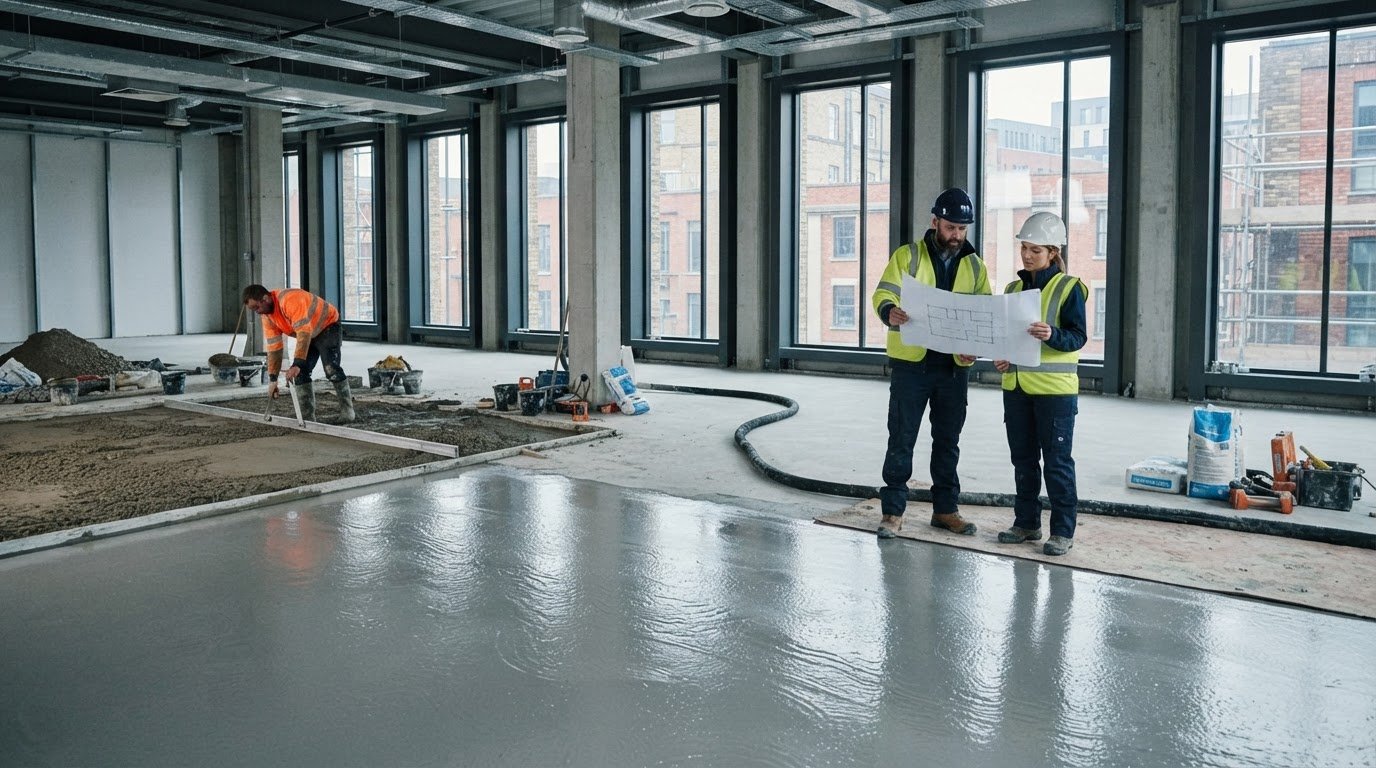
The lowest cost per square metre isn’t always the lowest-cost choice for a commercial floor. The floor screeding cost per m2 for commercial projects depends on the screed type, floor area, required depth, preparation and installation requirements, so there isn’t one rate that fits every job.
It’s understandable to focus on the headline figure when budgeting a fit-out, but comparing like with like matters just as much. A quote can cover different combinations of materials, labour, pumping and floor preparation, while liquid and traditional screed have different installation characteristics.
This guide explains how liquid screed pricing is structured, what affects labour and project quotes, and how liquid screed compares with traditional sand and cement screed. It also shows how project scale and site conditions can affect the value of a rate per square metre, so you can assess the full scope behind a commercial flooring budget.
Key Takeaways
- Separate labour from materials and pumping when assessing a screeding quote, so you can compare the same scope of work.
- Account for floor area, screed depth and preparation, as each can change material quantities and the overall estimate.
- Compare liquid and traditional screed by both installation requirements and project needs, not just the headline rate.
- Consider how screeding fits alongside interior works such as drylining and plastering when planning a commercial fit-out.
How Much to Screed a Floor (Labour Only)?
Labour-only costs cover placing and levelling the screed, not materials or every site charge. For commercial floors, compliance with UK Building Regulations and relevant British Standards depends on the complete floor build-up and its intended use. The specification should define the screed, substrate, thickness and required finish.
Installation Labour and Speed
Installation labour covers the crew’s time to distribute, level and finish screed across the prepared floor. The area a team can complete during a shift affects both labour planning and how the work fits the wider programme.
Liquid screed can be more than 10 times quicker to lay than traditional screed. A 2-to-3-person team using mechanical equipment can process hundreds of square metres per shift, while a typical UK room takes 6 to 7 hours to screed. These are different job scales, so the floor area and method matter when comparing labour allowances.
A professional operator can pour a house floor using liquid screed in a couple of hours. This illustrates the potential speed of placing the material, not the time needed for preparation, site access or subsequent trades. On a commercial floor, the installation sequence and available working area also shape the labour plan.
Equipment and Labour Costs
Equipment costs cover the plant needed to mix, deliver or place screed; labour costs cover the people operating it. Mechanical screeding equipment can increase the area completed per shift, so consider both crew size and expected output when assessing larger floors.
Labour-only estimates vary with the floor area, access, preparation and chosen installation method. A liquid screed job may also involve pump setup and a minimum call-out covering 20m² to 30m², affecting smaller areas more sharply than a large floor. Clearing the work area before the team arrives helps keep installation time focused on screeding.
On a commercial project, labour costs depend on the scope. Floor area, access, preparation, equipment and installation method all affect the estimate. Compare quotes by checking which tasks and equipment each labour allowance covers, rather than treating the rate as the full project cost.
What Impacts Floor Screeding Costs?
Thickness determines material volume, while floor area sets how much screed the project needs overall. In the UK, London and surrounding areas may cost 25% to 35% more than other regions.
Screed Thickness and Material Volume
Screed thickness is the depth of material laid across the floor, and it directly affects the volume required. A deeper layer needs more material, increasing the supply element of the estimate.
For example, a 20 kg bag of screed usually covers around 1 m² at a depth of 10 mm. Liquid screed floors are usually poured at 40mm to 50mm, so increasing depth by 5mm incrementally increases material costs. The specified build-up and floor levels therefore affect quantities before installation begins.
Different constructions also need different depths. Traditional unbonded sand and cement screed typically requires 65mm to 75mm, while screed bonded directly to concrete should generally be around 25mm to 40mm. Those variations change the volume calculation across the same floor area.
Floor Area and Total Cost
Floor area is the measured surface to be covered and determines the total quantity of screed required. A larger area generally needs more material, even when the rate per square metre is lower.
Thickness affects the calculation too: multiply the floor area by the specified depth to estimate the material volume. Even a small adjustment across a broad floor can add up across the order.
Regional Cost Variation
Regional cost variation means project estimates can differ between locations in the UK. The same floor specification may attract different local costs, so compare quotes for equivalent scopes.
London and surrounding areas may be 25% to 35% higher than other UK areas. The location can therefore affect the overall budget alongside floor area and depth. For a clear scope, compare quantities and specifications consistently, and use commercial screeding information as a relevant reference when planning the work.
How Much Does Liquid Screed Cost Per m2?
Liquid screed costs depend on the formulation, installation scope and floor construction. Compare what each estimate includes, and consider drying requirements alongside the material choice.
Costs by Screed Type
Standard, fast-drying and liquid screeds have different material and installation requirements, which affects project cost comparisons. Fast-drying screed can carry an added cost for a quicker programme, while liquid screed pricing also reflects pumping and supply arrangements.
For a fair comparison, separate material supply from labour and installation, then check whether pumping is included. A quote for flowing screed supplied and pumped covers a different scope from a supply-only estimate. Floor area and required depth also affect the quantity and overall cost.
Some fast-drying screeds can dry in as little as 12 hours. That figure describes a possible drying time, not automatic readiness for tiling. The surface must be dry enough for the chosen floor finish, with the project specification and product requirements guiding the sequence.
Rapid-drying additives can add to material costs, so weigh that extra against the value of a shorter programme. Traditional sand and cement screed may need about one day of curing per millimetre of thickness before final floor coverage. A 50 mm screed can take about seven weeks to dry under the guide provided.
Costs of Bonded, Unbonded and Floating Screed
Bonded, unbonded and floating screeds describe how the screed relates to the substrate or underlying floor build-up. This construction affects the required depth and material volume, which changes the basis for comparing costs.
Screed bonded directly to concrete should generally be around 25 mm to 40 mm thick. Traditional unbonded sand and cement screed typically requires 65 mm to 75 mm, using more material across the same area. A floating screed sits over an intermediate layer, such as insulation, so its specified build-up also influences quantities.
There is no single cost difference that applies to all three constructions. Compare the specified build-up, screed type, depth and installation work included. For tiling, consider drying time separately: a faster-drying option may affect the programme, but the floor finish must still meet the screed’s drying requirements.
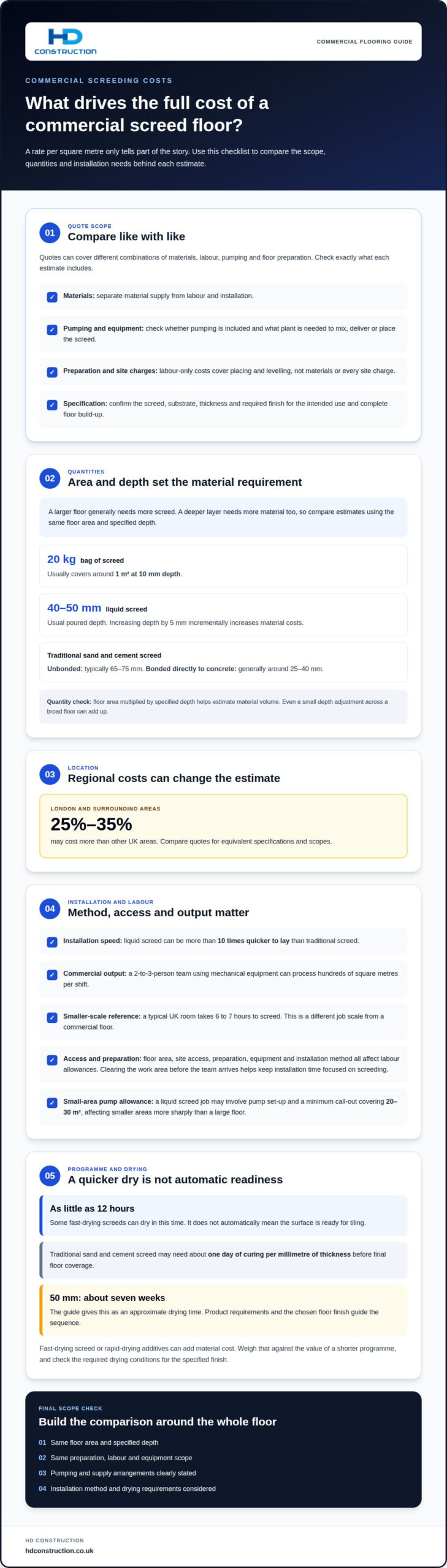
Liquid and traditional screed cost comparison
Liquid and traditional screed can differ in supply, installation method and programme impact. Compare the full installed scope, not just the material allowance, to understand how each option affects a commercial floor budget.
Liquid screed is pumped and flows across the prepared floor, while traditional sand and cement screed is placed and levelled using a different method. The choice affects the work sequence, equipment and labour needed on site. A lower material allowance alone does not show which system costs less overall.
Separate each estimate into materials, delivery, pumping or mixing equipment, labour, preparation and any specified additives. Then compare equivalent floor areas and build-ups. For example, a liquid screed quote that includes pumping cannot be compared directly with a traditional screed material-only allowance. Distinguishing supply-only from supply-and-install pricing is essential for a fair comparison.
Programme requirements matter too. Liquid screed can be installed faster than traditional screed, which may help coordinate following trades. However, installation speed is not the same as drying time or readiness for the final floor finish. Include the specified drying requirements and handover sequence in your assessment. A quick pour does not mean the floor is immediately ready for tiling or other finishes.
Traditional screed may suit a project when its construction and installation method align with the floor specification. Liquid screed may suit a layout where flowing application and pumping support the planned work. Neither option is automatically cheaper: depth, floor area, access, preparation and included work all affect the comparison.
For commercial screeding, the price depends on the project and is provided after a quote request, with floor area, screed type, depth, access, preparation and installation scope affecting the estimate. Compare those details before deciding which system best fits the floor and programme. To discuss the requirements of a commercial floor, contact HD Construction about screeding.
HD Construction: Drylining
HD Construction supports commercial projects where floor works sit alongside interior fit-out requirements. Its Drylining and Plastering services help form finished internal spaces, while SFS (Steel Framing System) and Taping & Jointing cover related wall construction and finishing scopes.
Discuss how floor screeding will be coordinated with internal partitions and finishes. Aligning the work sequence helps the project team plan floor and wall activities, reduce trade clashes and support an organised handover. The right scope depends on the building design and work required.
For commercial projects combining screeding with interior construction, HD Construction offers Drylining, Plastering, SFS (Steel Framing System) and Taping & Jointing. Contact HD Construction to discuss your project requirements.
Plan the Next Stage of Your Commercial Floor
Use your screed decision to shape the next stage of project planning, not just the flooring allowance. A clearly defined scope helps align the floor specification with the programme, follow-on trades and intended finish. That makes the floor screeding cost per m2 for a commercial project more useful as a budgeting measure, because it sits within the wider construction plan.
Before work proceeds, bring together the relevant project information: floor design, intended finish, site sequence and interfaces with other packages. This gives the project team a practical basis for coordinating decisions and identifying where responsibilities meet. It also connects the floor package to the wider fit-out instead of treating it as an isolated task.
HD Construction can discuss how commercial interior works fit your project requirements. Contact HD Construction to discuss your project and take the next planning step with confidence.
Frequently Asked Questions
How Long Does Drying Take?
Drying time depends on screed type, depth and site conditions, and it affects when floor finishes can be installed. A 50 mm screed can take about seven weeks to dry under the guide cited in this article, while some fast-drying screeds can dry in as little as 12 hours. These times aren’t interchangeable: confirm the surface is ready for the specified finish before tiling.
What’s Included in a Floor Screeding Quote?
A floor screeding quote should set out the work and materials covered, including screed type, measured area, specified depth and installation scope. Check how it accounts for site preparation, delivery, pumping or other equipment, labour and additives. A supply-only figure excludes installation, so it cannot be compared directly with a price covering supply and laying. VAT should also be clearly identified.
What is the average commercial floor screeding cost per m² in the UK?
A typical market range for floor screed supply and installation is £33 to £35 per m², with a median of about £33. This is a broad market reference, not a fixed rate for every commercial project. Scope, floor specification and project scale affect how a quote compares with that range, so use it as an initial budgeting point rather than a complete project allowance.
How much does sand and cement screed cost per m² for commercial projects?
There is no single commercial rate for sand and cement screed that applies to every project. Material quantities depend on the specified build-up, while installation scope affects labour and equipment requirements. For a useful comparison, distinguish supply-only from installed costs and compare the same floor area, thickness and preparation requirements. A quote based on a different construction or scope is not a like-for-like comparison.
How much does liquid or anhydrite screed cost per m² commercially?
Liquid or anhydrite screed has no single per-square-metre price for all commercial floors. The estimate depends on the specified material, required depth, project area and whether delivery, pumping and installation are included. Compare the full scope with alternatives, including the programme and drying requirements for the chosen floor finish. This distinguishes a material rate from the cost of a completed screeding package.
What additional costs apply for floor preparation, insulation, pumping and underfloor heating?
Additional costs depend on the project requirements and whether each item is included in the base quote. Preparation may involve removing existing floor coverings or preparing the substrate; insulation and underfloor heating affect the floor build-up and screed specification. Pumping may be listed separately, depending on the installation arrangement. Compare each item with the stated scope and quantities so excluded work is not mistaken for part of the total.